

Beginner's Guide to AI Ethics
النقاط الرئيسية
- AI ethics asks who an automated decision helps, who it harms and who answers for it, which makes it an engineering question rather than a garnish added at the end.
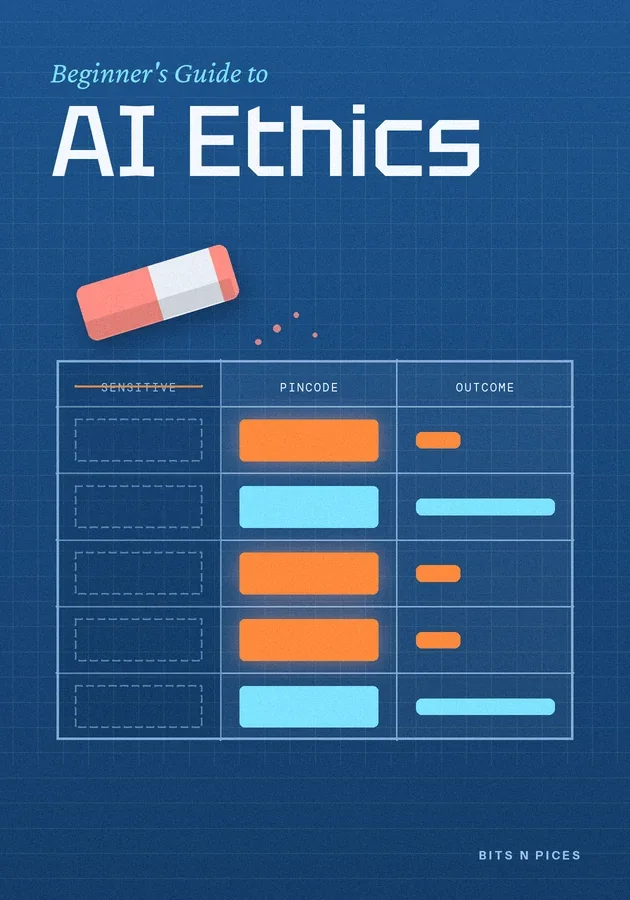
- Deleting the sensitive column does not remove bias, because pincode, school name and shopping habits stand in for it; you need the attribute to measure fairness at all.
- There are several reasonable definitions of fairness and a system usually cannot satisfy them all, so the real work is choosing one openly and defending the choice.
- Your first three moves are to map everyone affected, measure outcomes across groups, and build a route for a person to question and reverse the decision.
- Models change the world they measure: a score that shapes who gets work also shapes tomorrow's data, so watch for loops that make a small bias grow.
داخل هذا الجزء
- Why this is an engineering question
AI ethics is the study of who an automated decision helps, who it harms, and who answers when it goes wrong. That sounds philosophical, but every one of those questions is settled in practice by choices a team makes: which data to collect, what to predict, which errors to tolerate, and whether a person can object.
- The vocabulary you need on day one
Fairness is the idea that a system should not treat people differently for reasons that are not relevant; the difficulty is that there are several precise versions of it. Equal error rates across groups, equal chance of a positive outcome, and equal treatment of identical individuals sound similar and often cannot all be true at once.
- Why deleting the sensitive column fails
The most common beginner instinct is to remove gender, religion, caste or age from the data and declare the model blind. This is called fairness through unawareness, and it fails for a reason worth understanding deeply.
- The first three moves
When you meet a new system, or a proposal for one, three moves will take you most of the way. First, map the affected people, and include those who are not users.
- Second-order effects and feedback loops
The advanced part of this subject is that models do not only describe the world; they act on it, and the world responds. A score that sends more orders to highly rated riders gives those riders more chances to earn ratings, and the gap widens without any change to the model.
- The classic beginner mistakes
Five mistakes recur so often that recognising them is half the skill. Treating accuracy as fairness: a model can be right ninety-five times in a hundred while every miss lands on the same community.
تعلمه بست طرق مختلفة
التصور، والخريطة الذهنية، والممارسة، والسيناريو، والتحدي، والمراجعة مكتوبة لهذا الكتاب.
اختبار وبطاقات تعليمية
اختبر ما قرأته واحتفظ به باستخدام التكرار المتباعد.
Bits AI
يجيب عن الكتاب أو القسم أو سؤال الاختبار الذي تقف عنده.





