

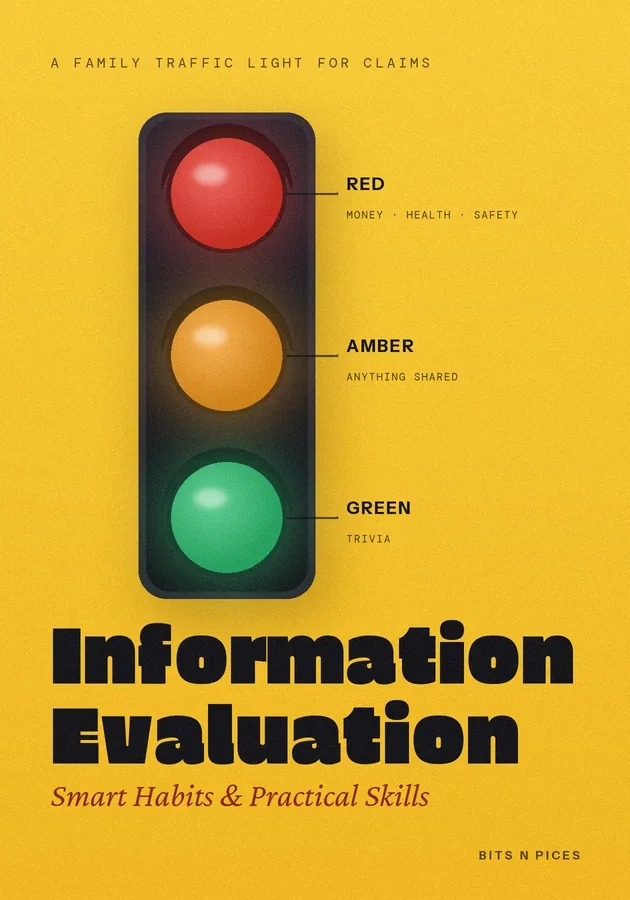
Information Evaluation: Smart Habits & Practical Skills
النقاط الرئيسية
- Give the family a traffic light for claims: green for trivia, amber for anything shared, and red for money, health, safety or reputations.
- Tie each check to a moment your family already has, such as the share button, the dinner news story or the homework search.
- Add friction to careless sharing and remove it from good checking: mute giant groups, stop auto-downloads, and pin trusted channels where thumbs land.
- Use the school run for a two-minute check: one claim, one colour call, and on Fridays one slip shared, parents first.
- Keep a written trust ledger of the sources your family relies on for each topic, and review it at the start of every school term.
داخل هذا الجزء
- A family traffic light for sorting claims
A busy household meets dozens of claims a day: forwards, headlines, homework sources, adverts, playground rumours. Nobody can check them all properly, and trying usually ends with checking none.
- Cues: attaching checks to moments you already have
Habits run on cues, moments that already happen and can trigger a small action. Good intentions such as being more careful fail because nothing reminds you of them at the right moment.
- Friction: slowing bad shares, speeding good checks
Friction means small obstacles that make a behaviour slower. Add it to careless sharing and remove it from good checking, and the family's default shifts without anyone needing more willpower.
- The two-minute school-run check
Rituals keep habits visible, and the best ones borrow a moment the family already shares. On the walk, bus stop or drive to school, spend two minutes on one claim.
- A family trust ledger, reviewed each term
Doubting well is only half the skill; a family also needs to know whom to trust, and for what. A trust ledger is a written list of the sources your household relies on, noting for each one the topics it covers well, its track record and whether it corrects mistakes openly.
- Tracking lightly and restarting after a slip
Tracking tells you whether habits are alive, but heavy tracking kills them. Keep one household number, such as checks before shares, as a tally on the fridge, and look at it monthly rather than daily.
تعلمه بست طرق مختلفة
التصور، والخريطة الذهنية، والممارسة، والسيناريو، والتحدي، والمراجعة مكتوبة لهذا الكتاب.
اختبار وبطاقات تعليمية
اختبر ما قرأته واحتفظ به باستخدام التكرار المتباعد.
Bits AI
يجيب عن الكتاب أو القسم أو سؤال الاختبار الذي تقف عنده.





