

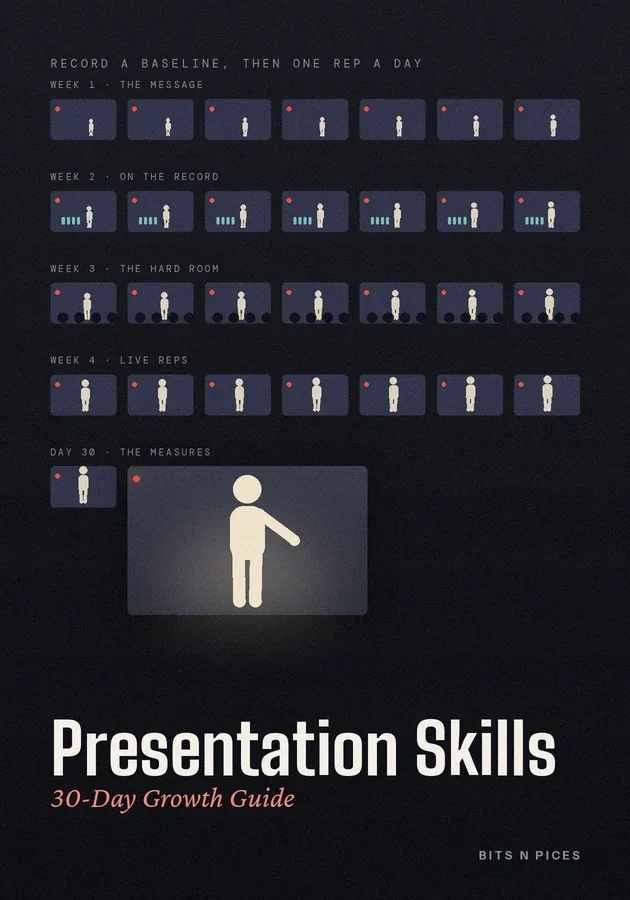
Presentation Skills: 30-Day Growth Guide
النقاط الرئيسية
- Record a three-minute baseline talk before day one, because progress you cannot see on day thirty is progress you will not believe.
- Before any slide exists, write the one sentence you want the most senior listener to repeat afterwards, and cut whatever does not serve it.
- Review each recording once with the sound off and once with your eyes closed, so posture and voice are judged separately and honestly.
- Rehearse the sceptical question, the bad news and the interruption out loud in week three, so the difficult room already feels familiar.
- When a week slips, shrink the daily rep to five minutes instead of restarting, and never let two missed days sit side by side.
داخل هذا الجزء
- How the four weeks are built
This programme assumes you already give presentations and want to become noticeably better within a month. It runs on one daily rep of ten to twenty minutes, four weekly themes and two measurements taken on day one and day thirty.
- Week one: design the message before the slides
Experienced presenters fail less from nerves than from the curse of knowledge: they know the material so well that they forget which steps the audience is missing. Week one fixes this with a daily rep on message design.
- Week two: delivery on the record
Week two turns your phone into a strict but fair coach. Each day, record a two-minute section of a real talk and review it in two passes.
- Week three: rehearsing the hard room
Most presenters rehearse the part they control and improvise the part they fear. Week three reverses that.
- Week four: live reps and sharper feedback
Practice in an empty room only takes you so far, because real listeners change your timing, your nerves and your choices. In week four, find at least two live but low-stakes chances to present: a five-minute update at a team meeting, a lunchtime explainer for new joiners, a briefing for a neighbouring department.
- Day thirty: the measures and the slip rule
On day thirty, record the same three-minute talk you recorded before day one, then watch both side by side. Compare four measures: whether a stranger could state your main point after one viewing, filler words per minute, how far you overran or underran, and how often you looked at people rather than the screen.
تعلمه بست طرق مختلفة
التصور، والخريطة الذهنية، والممارسة، والسيناريو، والتحدي، والمراجعة مكتوبة لهذا الكتاب.
اختبار وبطاقات تعليمية
اختبر ما قرأته واحتفظ به باستخدام التكرار المتباعد.
Bits AI
يجيب عن الكتاب أو القسم أو سؤال الاختبار الذي تقف عنده.





