

Information Evaluation: Skills for the Future
Kernaussagen
- As single answers replace lists of links, teach children to ask what an answer is built from and to open two of its sources.
- When someone says a recording could be fake, answer with accountability: who published it first, do they stand behind it, and who confirmed it independently?
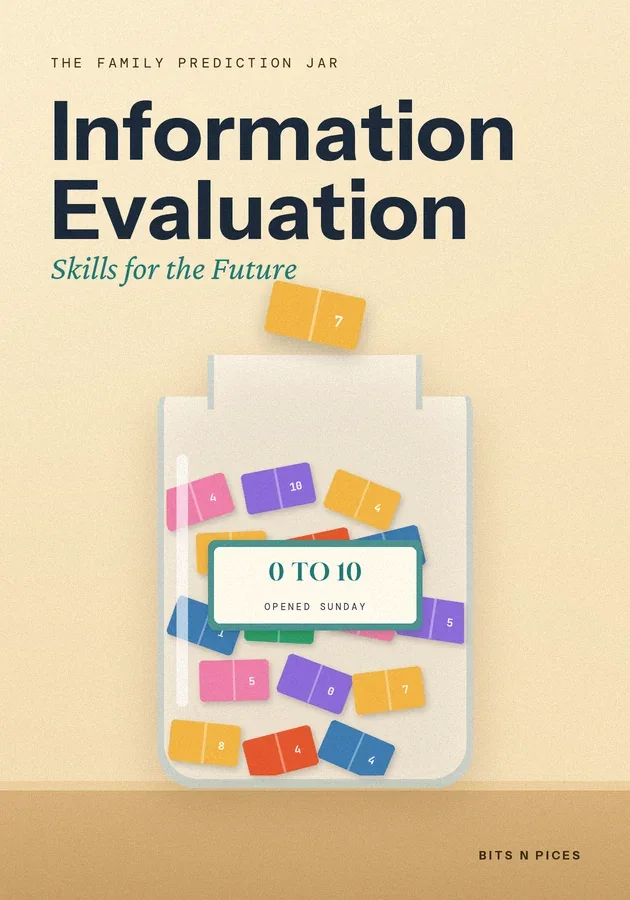
- Build calibration with a family prediction jar: weekly forecasts with a sureness from zero to ten, opened and scored the following Sunday.
- Teach children how a field checks its own work, so one confident voice can be weighed against what most people who study the subject say.
- Warmth is not evidence: when a friendly voice or a message tailored to your child asks for belief, money or a password, slow down together.
In diesem Bit
- From lists of links to single answers
For most of the last twenty years, looking something up meant scanning a page of results and noticing, at least dimly, that sources disagreed. Over the next decade that step is moving inside the tools.
- The fake excuse and the value of a name
Convincing photos, voices and video are becoming cheap to make, and the damage runs two ways. Fakes get believed, and real evidence gets waved away, because anyone caught on camera can now claim the footage was machine-made.
- Calibration and the family prediction jar
Among the skills that will not date, calibration may be the most underrated. It means matching your confidence to reality: when you say you are eight out of ten sure, you should be right roughly eight times in ten.
- How fields check their own work
Every trustworthy field has a way of catching its own mistakes. Newsrooms confirm with a second source and an editor, and print corrections.
- Warm voices and tailored messages
Two risks will grow as information becomes more personal. The first is trust by familiarity.
- Keeping up: the two-way swap
The tools your children use will change several times before they leave home, so plan for learning rather than for any product. The most useful routine is a two-way swap.
Lerne es auf sechs Arten
Visualisierung, Mindmap, Praxis, Szenario, Challenge und Review wurden für dieses Buch erstellt.
Quiz und Karteikarten
Teste, was du gelesen hast, und behalte es durch Spaced Repetition im Gedächtnis.
Bits AI
Es beantwortet Fragen zum Buch, zum Abschnitt oder zur Quizfrage, bei der du dich gerade befindest.





