

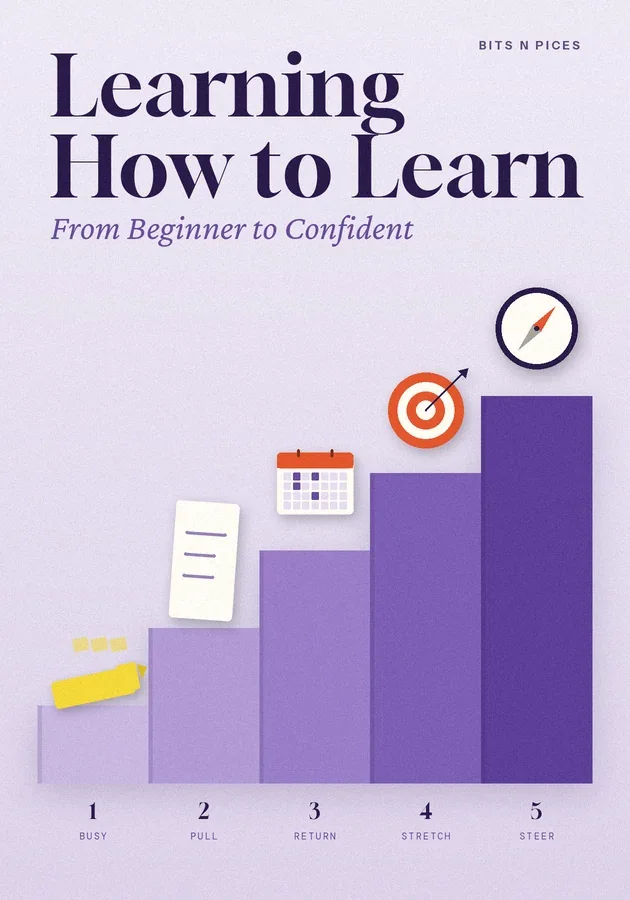
Learning How to Learn: From Beginner to Confident
Kernaussagen
- Most beginners start on the busy rung, rereading and highlighting for hours, and the first step up is simply closing the book before you feel ready.
- You have reached the second rung when every study session starts with a blank page and ends with a list of what you could not recall.
- Climbing to the third rung means booking return visits in your calendar, so old topics come back before they fade instead of after.
- Confident learners practise where it hurts, choosing their weakest skill, mixing problem types and getting quick, specific feedback on every attempt.
- Judge your rung by evidence, such as unaided recall after a week or a problem you have never seen, not by how many hours you put in.
In diesem Bit
- Rung one: busy but not yet learning
Almost everyone starts here. On the first rung, learning means time spent with the material: reading chapters twice, highlighting in three colours, watching tutorials at double speed, rewriting notes neatly.
- Rung two: pulling it out of your head
On the second rung, every session includes retrieval, getting information out of memory without looking. The simplest tool is a blank page.
- Rung three: coming back before you forget
The third rung adds timing. Recall on its own strengthens memory, but recall after a gap strengthens it more, because pulling back something half-faded takes extra effort.
- Rung four: practising where it hurts
On the fourth rung, you stop spending most of your time on what you already do well. Deliberate practice means finding your weakest specific skill, working on it with full attention and getting quick feedback on every attempt.
- Rung five: steering your own learning
The top rung is not about knowing everything; it is about running your own learning. Confident learners plan what to study, monitor how it is going and adjust when it is not working.
- Plateaus, slips and proof you have climbed
Progress up the ladder is rarely smooth. Plateaus, stretches where nothing seems to improve, are normal and often come just before a jump.
Lerne es auf sechs Arten
Visualisierung, Mindmap, Praxis, Szenario, Challenge und Review wurden für dieses Buch erstellt.
Quiz und Karteikarten
Teste, was du gelesen hast, und behalte es durch Spaced Repetition im Gedächtnis.
Bits AI
Es beantwortet Fragen zum Buch, zum Abschnitt oder zur Quizfrage, bei der du dich gerade befindest.





