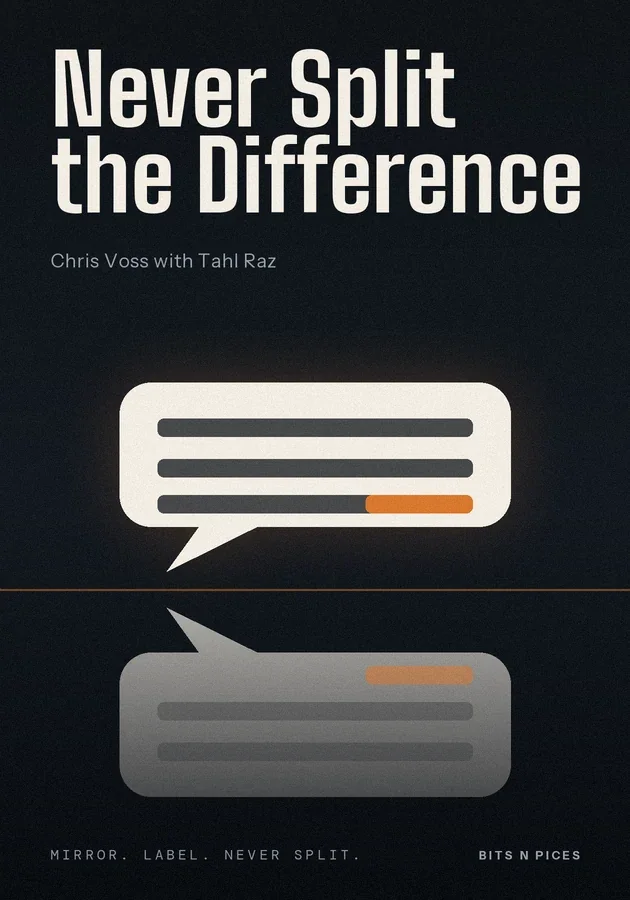
Never Split the Difference
Kernaussagen
- Verhandeln heißt zuhören und fühlen, nicht Kompromisse schließen
- Spiegle die letzten Worte deines Gegenübers, um mehr zu erfahren
- Benenne Gefühle des Gegenübers offen, um Vertrauen zu schaffen
- Ziele auf ein echtes »Stimmt genau«, nicht auf ein höfliches Ja
- Nutze Wie- und Was-Fragen, damit die Gegenseite deine Probleme löst
In diesem Bit
- Verhandeln ist Zuhören, keine Logik
Imagine a bank robbery with hostages inside, and a negotiator on the phone whose only tools are his voice and his ears. That was the job of Chris Voss, a former FBI hostage negotiator, and this book turns what he learned in those situations into a method for everyday bargaining.
- Spiegeln und Benennen öffnen Türen
Two of the simplest tools in the book are mirroring and labelling. Mirroring means repeating the last 1 to 3 words the other person said, with a slight upward tone, and then staying quiet.
- Ziel auf »Stimmt genau«, nicht auf Ja
Most people chase a yes, but Voss argues that yes is often worthless. There is the counterfeit yes people give to escape a pushy salesperson, and the confirmation yes that commits to nothing.
- Gezielte Fragen bewegen am meisten
When someone makes an unreasonable demand, the instinct is to argue or refuse. Voss offers a better move: ask a calibrated question, an open question beginning with how or what that pushes the other side to work on your problem.
- Hart verhandeln, Black Swans aufspüren
When the conversation finally turns to numbers, Voss lays out a structured approach he calls the Ackerman model. Set your target, then open with an anchor far from it, and move in progressively smaller steps so each concession feels like you are running out of room.
- In die Praxis umsetzen
This week, practise mirroring in a low-stakes chat: repeat the last few words a colleague says, stay silent, and notice how much more they tell you. In your next disagreement, label the other person's emotion before you make your point, and watch the temperature drop.
Lerne es auf sechs Arten
Visualisierung, Mindmap, Praxis, Szenario, Challenge und Review wurden für dieses Buch erstellt.
Vertont
Hör dir dieses Bit an, gelesen von Michael oder Bella.
Quiz und Karteikarten
Teste, was du gelesen hast, und behalte es durch Spaced Repetition im Gedächtnis.
Bits AI
Es beantwortet Fragen zum Buch, zum Abschnitt oder zur Quizfrage, bei der du dich gerade befindest.