

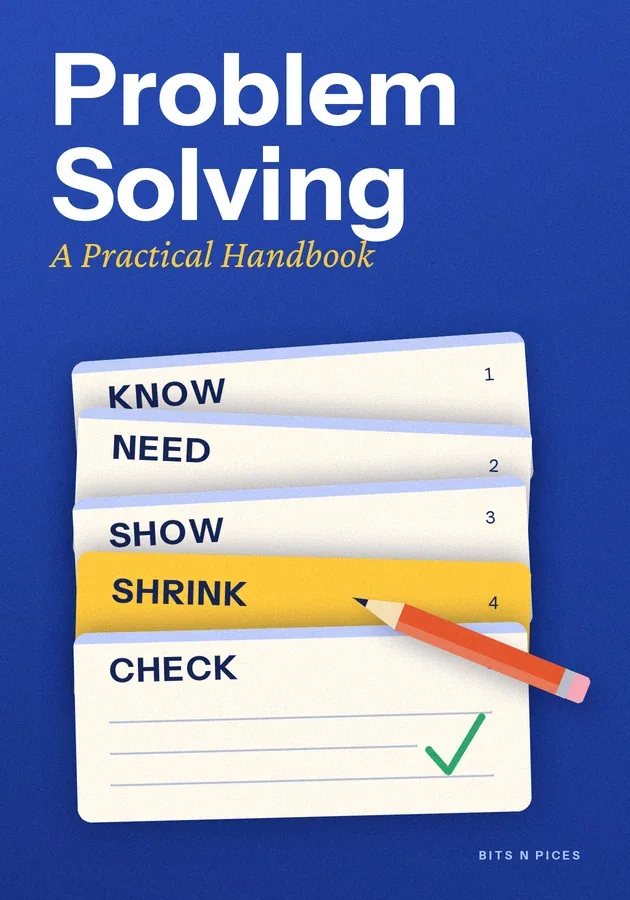
Problem Solving: A Practical Handbook
Kernaussagen
- When something at home breaks, run the free checks first, then swap in parts you know work, one at a time, before buying anything new.
- Give a stuck child five words to work through, know, need, show, shrink and check, and point to the next word instead of the next step.
- End repeated sharing quarrels with a fair procedure children can see, such as one cuts and the other chooses, a timer or a rota.
- Plan big family days backwards from the date, and give every child at least one task with a name and a deadline beside it.
- Before trips and big days, list what could go wrong with the children, write one plan B for each, and practise the most important aloud.
In diesem Bit
- Free checks and swap tests for broken things
When something at home stops working, a two-stage procedure finds many faults without buying anything. Stage one is the free checks: is it switched on, charged, connected, empty or full?
- Stuck on homework: know, need, show, shrink, check
When a child is stuck on a school problem, a short routine helps more than an explanation. Know: what does the question already tell you?
- Fair procedures for sharing quarrels
Many family problems are sharing problems: one television, one window seat, one last slice. Arguing about fairness rarely ends them, but a fair procedure often does, because children accept a process they can see.
- Planning a family project backwards
Big family jobs, such as a move, a grandparent's birthday lunch or the first week at a new school, go wrong when they are planned forwards from today and run out of time. Plan them backwards instead.
- Plan B lists for trips and big days
Before a trip, a wedding or an exam week, spend ten minutes on a plan B list. Ask each person, children included, what could go wrong.
- Challenge cards: practising through play
Problem-solving skill grows well on problems that are safe to get wrong, and play supplies plenty of them. Once a week, draw a challenge card from a jar.
Lerne es auf sechs Arten
Visualisierung, Mindmap, Praxis, Szenario, Challenge und Review wurden für dieses Buch erstellt.
Quiz und Karteikarten
Teste, was du gelesen hast, und behalte es durch Spaced Repetition im Gedächtnis.
Bits AI
Es beantwortet Fragen zum Buch, zum Abschnitt oder zur Quizfrage, bei der du dich gerade befindest.





