Storytelling: A Practical Handbook
Kernaussagen
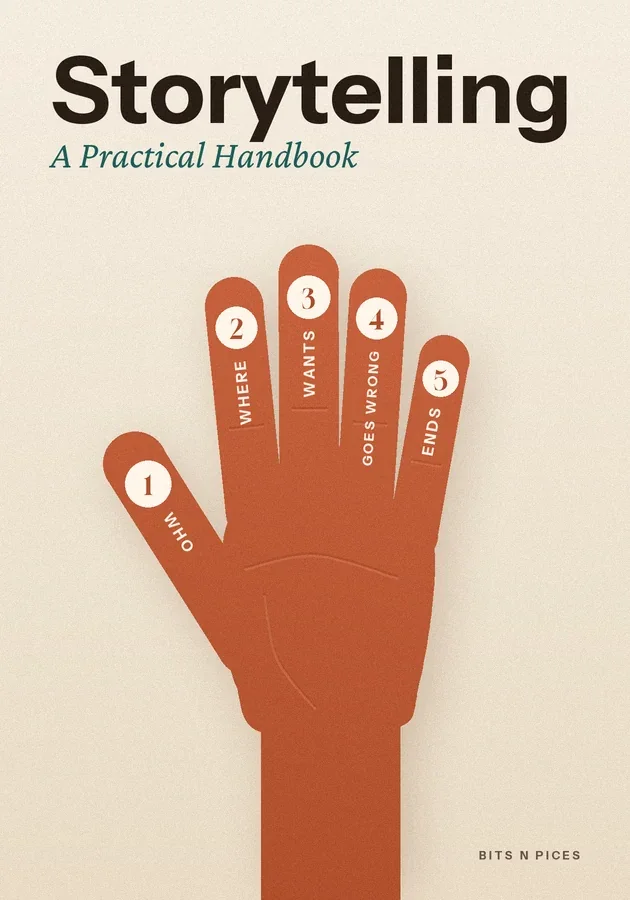
- Plan any story on one hand, who, where, what they want, what goes wrong and how it ends, whether it is for bedtime or a work briefing.
- When you tell a story aloud, give each main character a small voice change, add a refrain your child can join and finish quieter than you started.
- Draw a family story map of numbered places, and let every number hold a story that someone in the family can tell.
- Make folded storybooks in which the child tells and draws while the adult writes down the child's words exactly as spoken.
- Respond to stories with one thing you pictured, one thing you felt and one question, and ask your children to do the same for yours.
In diesem Bit
- The one-hand story plan
Every routine in this handbook starts from one tool, and it fits on a hand. The thumb is who the story is about.
- Telling a story aloud: voices, refrains, sounds
A story you know well can still fall flat if it is told in one steady tone. Four small techniques fix that, and none needs acting talent.
- Drawing a family story map
A family story map turns places into stories, and it needs only a large sheet of paper and some pencils. Draw your home in the middle, then add the places your family knows: school, the market, the bus stop, a grandparent's house, the park.
- Making a folded storybook together
A folded storybook turns a spoken story into something a child can hold, reread and give away. Take two sheets of paper, fold them in half together and staple or stitch the fold to make an eight-page booklet.
- Acting it out: the five-minute family play
Acting a story out teaches children what a story needs faster than any explanation, because a play falls apart without a clear want and a clear ending. Keep it to five minutes.
- Feedback that flows both ways
How you respond to a child's story decides whether they tell another. Use a three-part response: one thing I pictured, one thing I felt, one question I have.
Lerne es auf sechs Arten
Visualisierung, Mindmap, Praxis, Szenario, Challenge und Review wurden für dieses Buch erstellt.
Quiz und Karteikarten
Teste, was du gelesen hast, und behalte es durch Spaced Repetition im Gedächtnis.
Bits AI
Es beantwortet Fragen zum Buch, zum Abschnitt oder zur Quizfrage, bei der du dich gerade befindest.