Storytelling: From Beginner to Confident
Kernaussagen
- Find your rung honestly by recording a two-minute story, counting the and thens and trying to state the point in one sentence.
- Strip any story to its before, turn and after, then rebuild it, keeping only what supports those three sentences.
- Enter late and leave early, slow down at the turn, and practise the same story at thirty seconds, two minutes and five.
- Decide what a story is for before you speak, adjust to the listener as you go, and recognise the moments to stay silent.
- Keep a bank of true stories, retire worn ones, stop always being the hero and never let a rare case pass as typical.
In diesem Bit
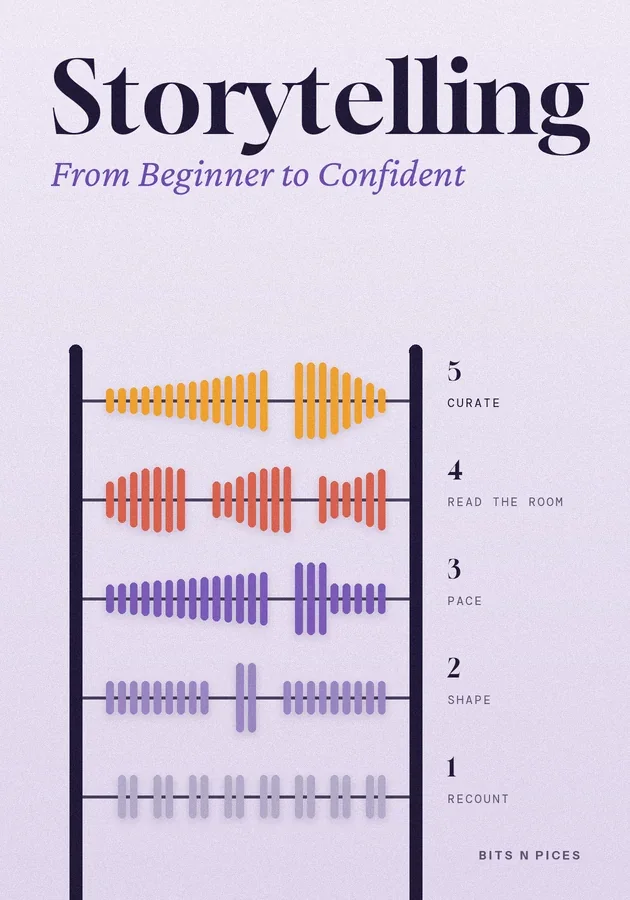
- Five rungs and how to find yours
Most people climb the same five rungs as storytellers, usually without noticing. On rung one, the recounter, events come out in the order they happened, joined by and then, with everything included and no clear point.
- Rung two: from recounting to shaping
The move from recounter to shaper is a change of question. The recounter asks what happened; the shaper asks what changed and why it matters to this listener.
- Rung three: selection, pace and tension
Selectors treat every sentence as a cost the listener pays. They enter late, at the last calm moment before the trouble, and leave early, soon after the turn.
- Rung four: reading the room as you go
Room readers make three decisions before they speak and keep adjusting while they talk. Before: what is this story for, to inform, persuade, comfort or connect, and what does this listener already know?
- Rung five: the curator's bank and its ethics
Curators keep a bank: ten to fifteen true stories, each noted with the point it can carry, the people it involves and when it was last told. The bank lets them pick the right story in seconds and notice when one is wearing out, which happens when colleagues start mouthing the punchline.
- Deliberate practice and proof you have moved up
Reading about stories moves no one up a rung; targeted repetitions do. Pick one story and one weakness at a time.
Lerne es auf sechs Arten
Visualisierung, Mindmap, Praxis, Szenario, Challenge und Review wurden für dieses Buch erstellt.
Quiz und Karteikarten
Teste, was du gelesen hast, und behalte es durch Spaced Repetition im Gedächtnis.
Bits AI
Es beantwortet Fragen zum Buch, zum Abschnitt oder zur Quizfrage, bei der du dich gerade befindest.