

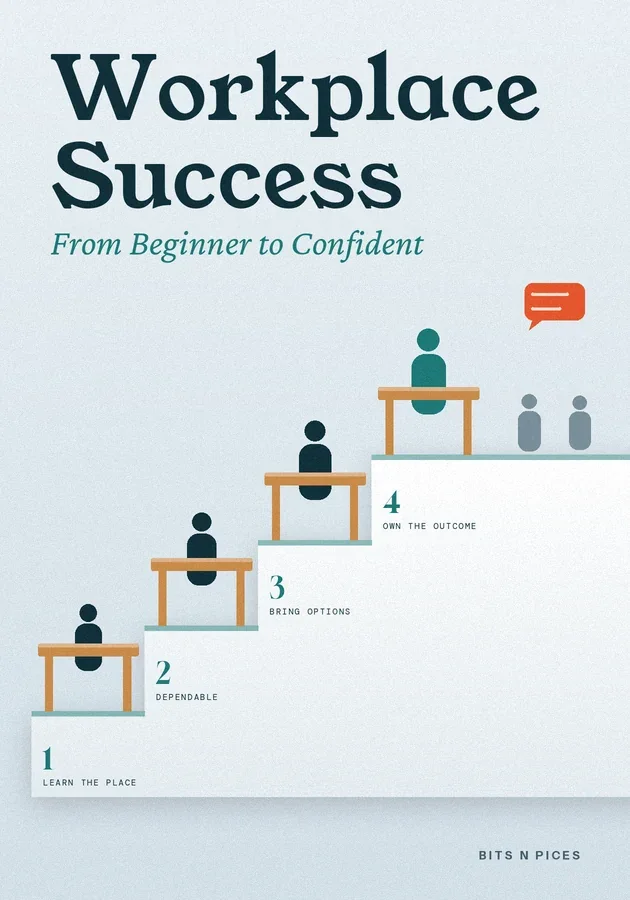
Workplace Success: From Beginner to Confident
Kernaussagen
- Mark which rung you are on for each part of your job, because most people are confident in some tasks and still learning in others.
- Batch your questions, learn new tasks by watching, trying and then going solo, and write every answer down so nothing needs explaining twice.
- Log each estimate beside the actual time taken; within a month you will know how much margin to add before promising a date.
- Bring problems with two options and a recommendation, and decide alone only when the choice is reversible, inside your area and within your limit.
- You have moved up a rung when other people's behaviour changes: they stop checking on you, bring you problems, or ask your view first.
In diesem Bit
- Four rungs from new to confident
Confidence at work is not a personality trait you either have or lack. It is the result of climbing a ladder of skills, and the ladder has roughly four rungs.
- Rung one: learning the place quickly
The learner's job is to become useful fast without wearing people out. The classic mistake runs in two directions: asking about everything, which drains colleagues, or asking about nothing, which leads to confident guesses and quiet errors.
- Rung two: dependable without being chased
On the second rung, the question people ask about you changes from can they do it to can I stop thinking about it. Dependability means your work arrives when you said, at the standard expected, without reminders.
- Rung three: bringing options, not just problems
The third rung is where surprises stop frightening you. A supplier misses a delivery, a customer changes the brief, a system goes down.
- Rung four: owning an outcome end to end
Owning an outcome means one result is clearly yours, not just the tasks inside it. It might be the monthly stock count, the onboarding of new clients or the weekly sales report.
- Practising on purpose and proving the climb
Climbing does not happen just by turning up; doing the same things the same way for years teaches surprisingly little. Deliberate practice means choosing one skill at a time, using it on purpose, getting feedback quickly and adjusting.
Lerne es auf sechs Arten
Visualisierung, Mindmap, Praxis, Szenario, Challenge und Review wurden für dieses Buch erstellt.
Quiz und Karteikarten
Teste, was du gelesen hast, und behalte es durch Spaced Repetition im Gedächtnis.
Bits AI
Es beantwortet Fragen zum Buch, zum Abschnitt oder zur Quizfrage, bei der du dich gerade befindest.





