

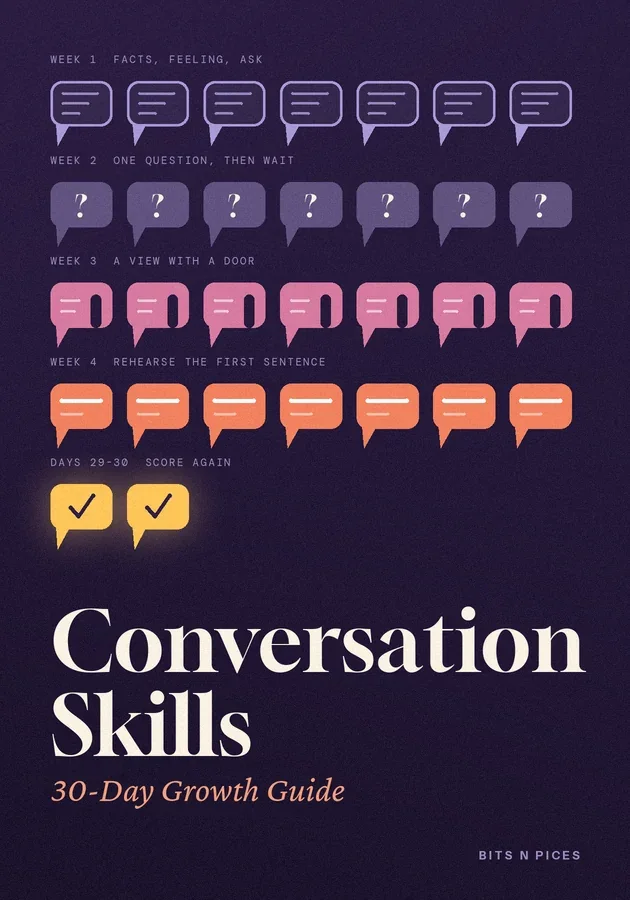
Conversation Skills: 30-Day Growth Guide
Puntos clave
- Listen for three layers in every message, the facts, the feeling and the ask, and name feelings tentatively so a wrong guess is easy to correct.
- Ask one question at a time, pin down vague words with a clarifying question, and wait a slow count of four before filling any silence.
- Offer opinions as a view with a door, what you think, one reason and what am I missing, using words that match how sure you are.
- Before a conversation you have been avoiding, rehearse only your first sentence, and when criticised ask for one example and find the part that is true.
- Score three conversations before day one and again on day twenty-nine, and when a week slips, resume with the smallest version instead of restarting.
Dentro de este bit
- The shape of the month and your baseline
This programme runs for four weeks with one theme each: attention, then questions, then opinions and stories, then the hard conversations most people avoid. Every day brings one micro-action, a small deliberate move of five to fifteen minutes built into conversations you would have anyway.
- Week one: listening for three layers
Week one trains attention. Every message carries three layers: the facts, meaning what happened; the feeling, meaning how the person feels about it; and the ask, meaning what they want from you, whether advice, help or simply a hearing.
- Week two: questions that open rather than close
Week two replaces reflex questions with ones that open a conversation. Three moves carry the week.
- Week three: opinions and stories that land
Many people listen and ask well, then vanish when it is their turn to say something. Week three trains the other half: offering opinions and short stories.
- Week four: the conversations you usually avoid
The final week takes on the conversations people postpone for months. Three kinds recur.
- Keeping score and rescuing a lost week
Measure three things. A daily tick shows whether you did the micro-action at all.
Aprende de seis maneras
Visualizar, Mapa Mental, Práctica, Escenario, Desafío y Repaso están escritos para este libro.
Cuestionario y flashcards
Pon a prueba lo que lees y reténlo con repetición espaciada.
Bits AI
Responde sobre el libro, la sección o la pregunta del cuestionario en la que te encuentras.





