Puntos clave
- Evolution is best understood as competition between genes, not between species or individuals
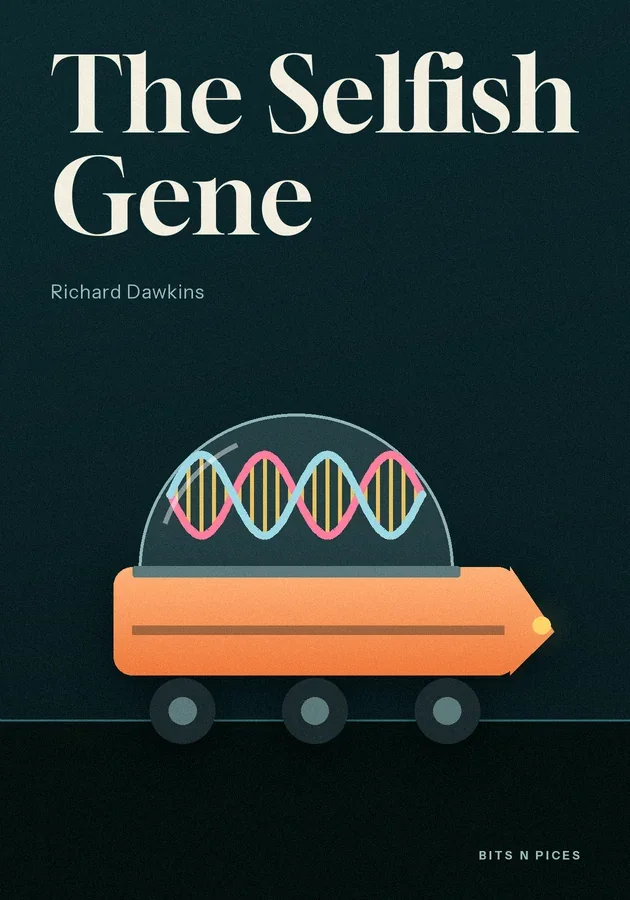
- Bodies are survival machines that genes build to copy themselves into the future
- Helping relatives makes genetic sense because they carry copies of your genes
- Cooperation can evolve between strangers when interactions repeat and cheats are punished
- Ideas spread and mutate like genes; Dawkins calls these cultural replicators memes
Dentro de este bit
- Evolution seen from the gene's chair
Ask why a bird risks its life to warn the flock about a hawk, or why a worker bee stings and dies for the hive. The old answer was that animals act for the good of the species.
- Bodies are survival machines
Dawkins invites you to look at an elephant, a tulip, or yourself, and see a vehicle. Around 4 billion years ago, molecules that could copy themselves appeared in the primordial soup.
- Why animals help their relatives
If genes are selfish, why does any creature help another? The answer is kin selection, and the arithmetic is beautiful.
- Nice guys can finish first
Between unrelated individuals, cooperation looks impossible for selfish genes, yet vampire bats share blood with hungry roostmates and cleaner fish are not eaten by their clients. Dawkins uses game theory to show how.
- Memes, the second replicator
In the final chapters Dawkins asks whether genes are the only things that evolve. He proposes that ideas, tunes, fashions, and beliefs are also replicators, jumping from brain to brain by imitation.
- Ponlo en práctica
This is a science book, but its lens is useful in daily life. This week, when you notice a strong urge, whether jealousy, cravings for sugar, or fierce protectiveness toward your child, ask what a gene might gain from it, then decide with your conscious mind whether to follow.
Aprende de seis maneras
Visualizar, Mapa Mental, Práctica, Escenario, Desafío y Repaso están escritos para este libro.
Narrado
Escucha este bit, leído por Michael o Bella.
Cuestionario y flashcards
Pon a prueba lo que lees y reténlo con repetición espaciada.
Bits AI
Responde sobre el libro, la sección o la pregunta del cuestionario en la que te encuentras.