

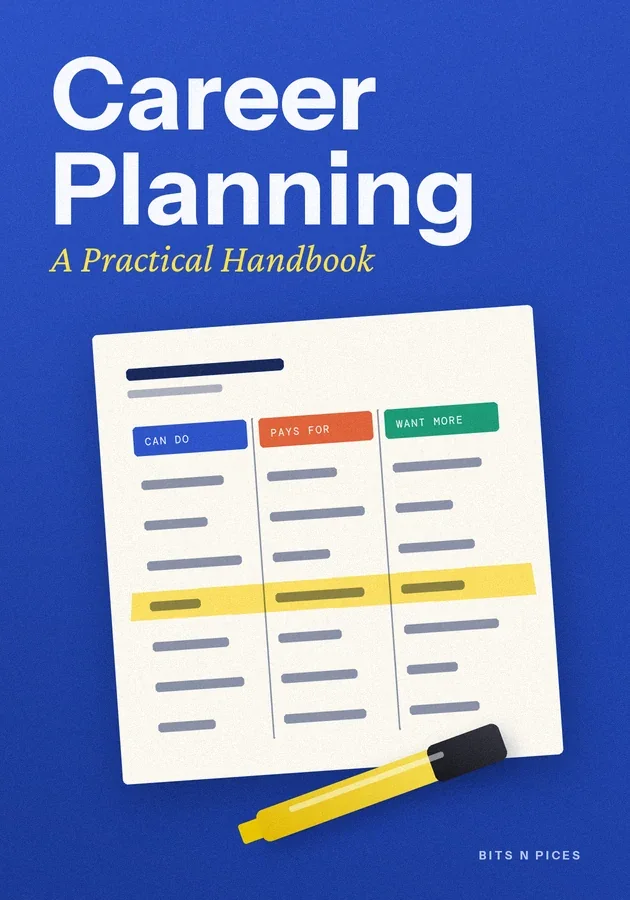
Career Planning: A Practical Handbook
Points clés
- Keep a one-page career map with three columns, what you can do, what the market pays for and what you want more of, and review it every quarter.
- Run a skills audit from real outputs of the last twelve months, rate the evidence behind each skill, and let the weak-evidence rows set your next project.
- Build an evidence file as you go, numbers, before-and-after artefacts and written feedback, so a profile or an interview answer is assembled, not invented.
- Scan ten job posts for a target role, tally the repeated requirements, and turn the gaps into a short list you can close in ninety days.
- Model every procedure at home in miniature, a proof folder for a teenager's projects or a kitchen-table mock interview, so children learn the method before they need it.
À l'intérieur de ce bit
- The one-page career map
Every procedure in this handbook hangs off a single sheet. Draw three columns.
- Running a skills audit on a Tuesday evening
A skills audit takes ninety minutes and needs no forms. Open your calendar, sent messages and project folders for the last twelve months and list every output you actually produced: a report, a rota, a fixed process, a trained colleague, a difficult customer retained.
- Building the evidence file and the public profile
An evidence file is a folder, physical or digital, that collects proof as it happens instead of reconstructing it under pressure. Put in it numbers with context, such as reduced picking errors from roughly nine percent to under three, before-and-after artefacts, screenshots of written thanks, and a short note of each project with the problem, what you did and what changed.
- The ten-post market scan
Before you close a gap, check that it is a real one. Collect ten current posts for the role you want, from three sources, and paste the requirements into a single table.
- Rehearsal drills for interviews and hard conversations
Reading about interviews does not prepare you; rehearsal does. Build a bank of eight stories from your evidence file, each told in four beats: the situation, the specific task you owned, the actions you took, and the measurable result.
- The 30/60/90 plan and the quarterly review
Turn the gaps from your scan into a written plan with three horizons. By day thirty, the setup: profile refreshed, evidence file current, first informational conversation done.
Apprenez-le de six manières
Visualisation, Carte mentale, Pratique, Scénario, Défi et Révision sont disponibles pour ce livre.
Quiz et cartes mémoire
Testez ce que vous avez lu et retenez-le grâce à la répétition espacée.
Bits AI
Il répond sur le livre, la section ou la question de quiz sur laquelle vous vous trouvez.





