

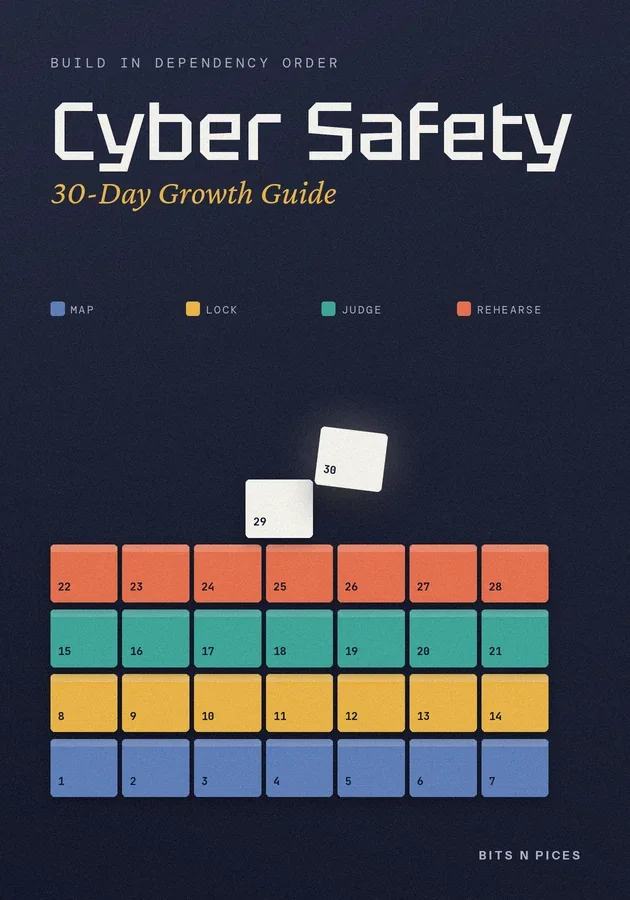
Cyber Safety: 30-Day Growth Guide
Points clés
- Build your thirty days in dependency order: map your accounts first, lock the top of the chain second, then train judgement and rehearse recovery.
- Your phone number and main email often recover each other and everything else, so a gap in either weakens every account you own.
- Ten to fifteen focused minutes a day beats a weekend overhaul, because small daily actions actually get finished, tested and remembered.
- A defence you have not tested is an assumption: restore a real file, rehearse a lost phone and prove your recovery route works without it.
- When a week slips, do the shortest version of each missed task rather than restarting, and keep the order of the weeks intact.
À l'intérieur de ce bit
- Why thirty days, and why this order
Cyber safety fails most often not from a missing tool but from a half-finished job: a password manager holding four accounts, or two-step verification on social media but not on the email that resets it. A thirty-day programme fixes that by breaking the work into daily actions of ten to fifteen minutes, arranged so that each week builds on the last.
- Week one: map the chain of keys
You cannot protect accounts you have forgotten. Spend days one to three building an inventory: search your email for words such as welcome, verify and receipt to surface every service you have ever signed up for.
- Week two: lock the top of the chain
With the chain drawn, secure it from the top. Days eight and nine set up a password manager and give it a master passphrase of several random words, written once on paper and kept at home until you know it by heart.
- Week three: sharpen judgement, shrink exposure
Locks achieve little if you can be talked into opening them. Days fifteen to eighteen train your eye.
- Week four: rehearse the bad day
The final week turns assumptions into evidence. Days twenty-three and twenty-four test backups.
- Keeping score and rescuing a slipped week
Measure outcomes, not effort. On day one and again on day thirty, score yourself on five questions.
Apprenez-le de six manières
Visualisation, Carte mentale, Pratique, Scénario, Défi et Révision sont disponibles pour ce livre.
Quiz et cartes mémoire
Testez ce que vous avez lu et retenez-le grâce à la répétition espacée.
Bits AI
Il répond sur le livre, la section ou la question de quiz sur laquelle vous vous trouvez.





