

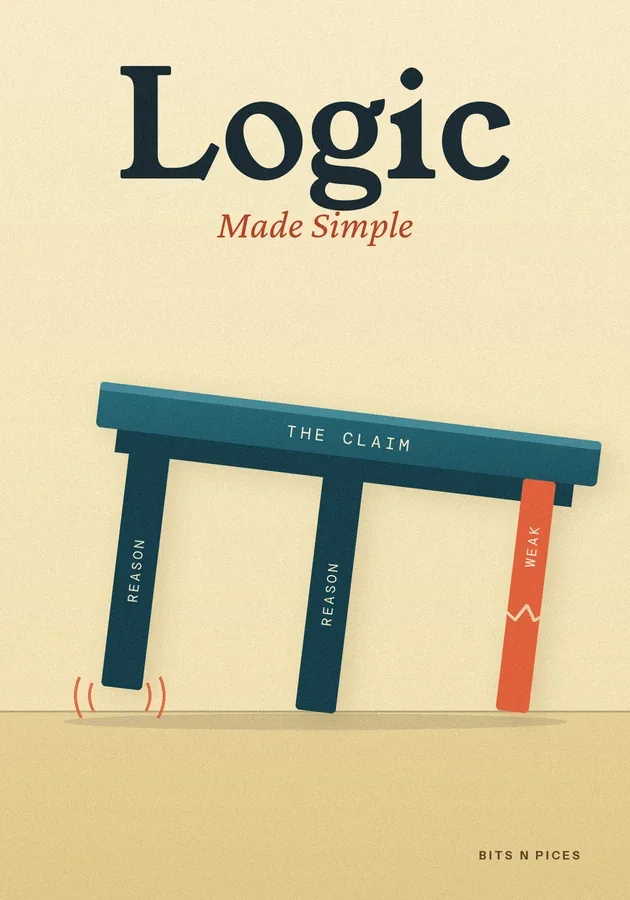
Logic Made Simple
Points clés
- Picture every argument as a table: the claim is the top, the reasons are the legs, and a table with weak legs will wobble.
- Logic is not maths and it is not coldness; it is simply checking whether reasons are true and actually hold up the claim.
- Three questions do most of the work: what exactly are you saying, why do you think so, and could it be something else?
- If-then is a one-way street, so wet ground does not prove it rained; ask your child what else could have made it wet.
- When someone says everyone is doing it or attacks the person instead of the point, calmly bring the talk back to the reasons.
À l'intérieur de ce bit
- Every argument is a table with legs
If logic sounds like a school subject you were bad at, start with a table. The tabletop is the claim, the thing someone wants you to believe or do.
- Five myths that make logic feel scary
Myth one: logic is maths. It shares some ideas, but everyday logic is simply checking reasons, and you already do it when you wonder whether a bargain is really a bargain.
- Three questions that do most of the work
If you remember nothing else from this book, keep three questions. What exactly are you saying?
- If-then is a one-way street
Many everyday mistakes come from driving the wrong way down a one-way street. If it rains, the ground gets wet.
- Two tricks worth spotting at home
Out of dozens of named mistakes, two turn up so often that spotting them covers much of daily life. The first is everyone is doing it.
- Small family habits that build clear thinkers
You do not need lessons or worksheets. Three small habits, repeated, do most of the work.
Apprenez-le de six manières
Visualisation, Carte mentale, Pratique, Scénario, Défi et Révision sont disponibles pour ce livre.
Quiz et cartes mémoire
Testez ce que vous avez lu et retenez-le grâce à la répétition espacée.
Bits AI
Il répond sur le livre, la section ou la question de quiz sur laquelle vous vous trouvez.





