Measure What Matters
Points clés
- An OKR is one inspiring objective plus 3 to 5 measurable key results that prove it
- Set few goals; if everything is a priority then nothing is
- Make OKRs public across the company so teams align sideways, not just top down
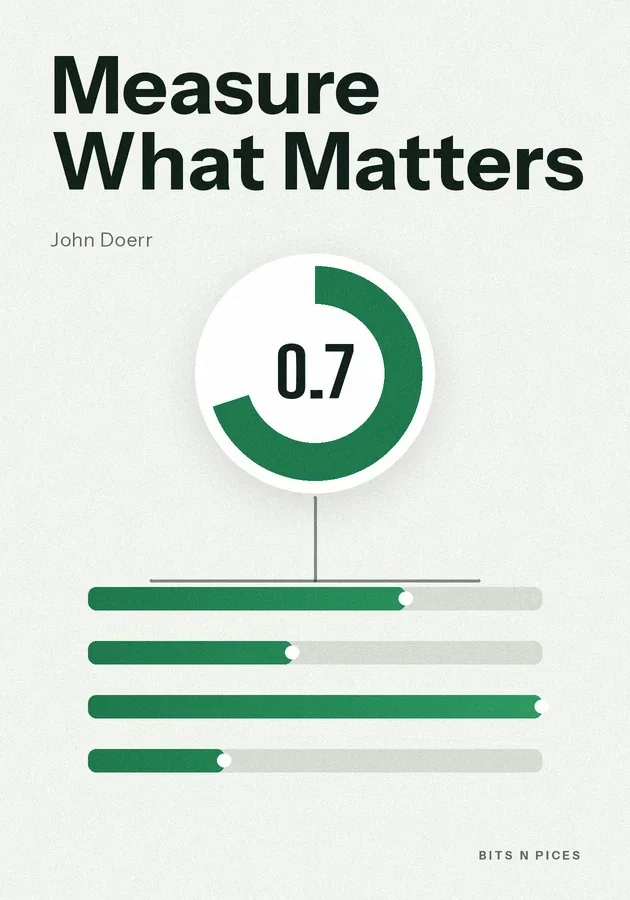
- Score honestly each quarter, and treat a 0.7 on a stretch goal as success
- Pair OKRs with frequent conversations, feedback and recognition, not with annual reviews
À l'intérieur de ce bit
- Goals you can actually see
In 1999 a venture capitalist walked into a tiny startup called Google and gave a presentation on a goal setting method he had learned at Intel under Andy Grove. The founders adopted it, and they still use it.
- Objective plus key results
The format is deliberately simple. An objective is what you want to achieve: significant, concrete, and a little inspiring.
- Focus and commitment
The first superpower of OKRs is focus. A company or team should carry only a handful of objectives per quarter, because attention spreads thin and the point of the exercise is to say no to good ideas so the great ones get done.
- Alignment through transparency
In most organisations goals are private, sitting in an HR system that nobody opens. Doerr's second and third superpowers, alignment and tracking, depend on making every OKR public, from the chief executive down to the newest hire.
- Stretch goals and continuous conversation
The fourth superpower is stretch. Doerr describes how Google expects teams to aim so high that hitting 70% of an aspirational key result is a good quarter, because a goal that is clearly reachable rarely produces new thinking.
- Passez à l'action
This week, write one objective for the next quarter for yourself or your team, in one sentence someone outside your field could understand. Add 3 key results that are numbers with dates, and delete any that describe activity rather than outcome.
Apprenez-le de six manières
Visualisation, Carte mentale, Pratique, Scénario, Défi et Révision sont disponibles pour ce livre.
Version audio
Écoutez ce bit, lu par Michael ou Bella.
Quiz et cartes mémoire
Testez ce que vous avez lu et retenez-le grâce à la répétition espacée.
Bits AI
Il répond sur le livre, la section ou la question de quiz sur laquelle vous vous trouvez.