

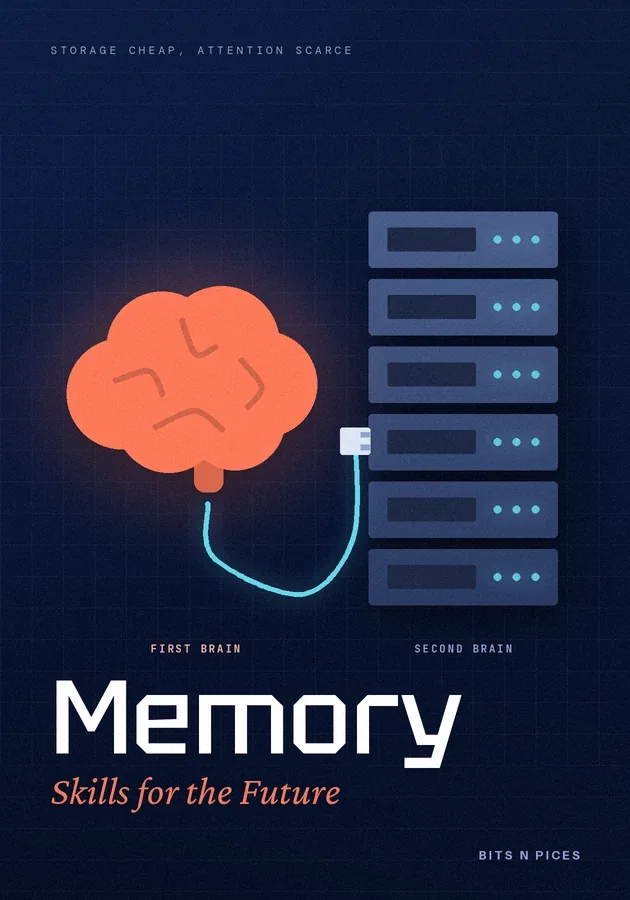
Memory: Skills for the Future
Points clés
- As storing information becomes almost free, the valuable skills shift to paying attention, judging what is true and learning new things quickly.
- A note-taking app or AI summary only helps if you know enough to search it well and connect what it returns.
- Relearning forgotten material is usually faster than learning it the first time, so little of what your child studies is truly wasted.
- Praise your child's methods, such as testing themselves, rather than their memory, and let them see you learning something new.
- Hearing a claim repeatedly makes it feel true, so teach your family to say where they first heard something before they share it.
À l'intérieur de ce bit
- Where memory tools are heading
Over the next five to ten years, remembering will increasingly be offered to us as a service. Meetings are already transcribed automatically, phones can search every photo by what is in it, and assistants are being built to recall past conversations and preferences.
- The skills that will keep their value
When records are cheap, the scarce skills are the ones a record cannot supply. Five stand out.
- A second brain still needs a first one
Digital notes, AI summaries and saved highlights are often called a second brain, and they can be excellent. But an external store only helps if you know enough to ask it the right question and to recognise what matters in what comes back.
- Relearning for careers that keep changing
Your children are likely to change roles several times in their working lives, and many parents will retrain at least once. That makes the speed of relearning one of the most useful memory skills there is.
- Raising children who can learn anything
Children who believe they simply have a good or bad memory tend to give up when material gets hard. Children who believe memory responds to method keep trying different approaches.
- Risks, opportunities and a family plan
The biggest risk ahead is not forgetting but misremembering. Hearing a claim repeatedly makes it feel familiar, and familiar feels true, even when it is false.
Apprenez-le de six manières
Visualisation, Carte mentale, Pratique, Scénario, Défi et Révision sont disponibles pour ce livre.
Quiz et cartes mémoire
Testez ce que vous avez lu et retenez-le grâce à la répétition espacée.
Bits AI
Il répond sur le livre, la section ou la question de quiz sur laquelle vous vous trouvez.





