

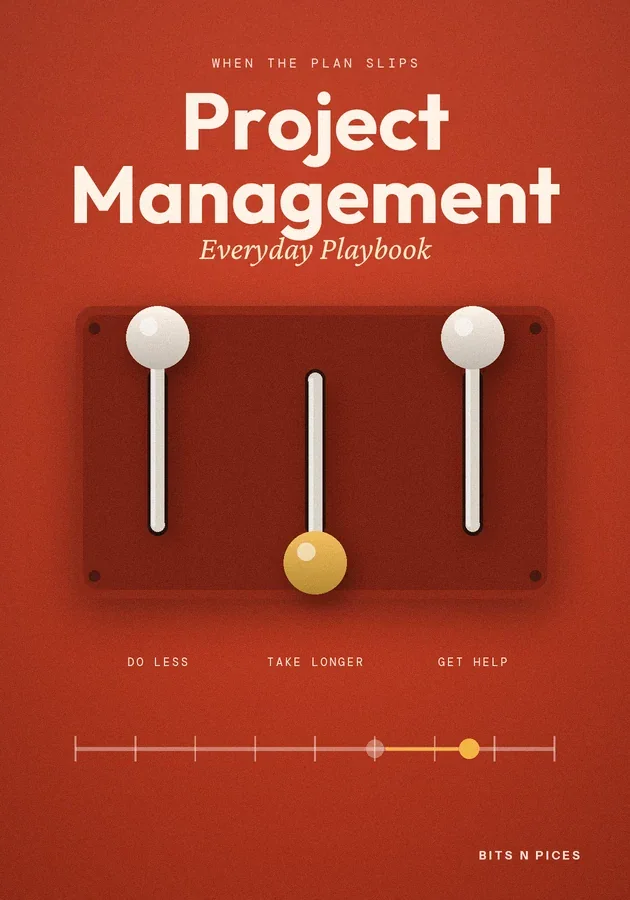
Project Management: Everyday Playbook
Points clés
- Before any family project starts, agree one sentence on what finished looks like, the date and the budget, so everyone works towards the same picture.
- When your child has a school project, be the sponsor who asks good questions, not the worker who quietly does the gluing.
- A job with no name and no day beside it is only a wish, so write both on a sheet everyone can see.
- When a plan slips, choose one lever out loud, do less, take longer or get more help, and let your children hear why.
- Close every family project with a ten-minute review, name your own mistake first, and keep a short list for next time.
À l'intérieur de ce bit
- When a big family job lands on you
The play: before you buy, book or move anything, write a one-sentence brief naming what finished looks like, the date and the budget. Then list what this project will not include.
- When the school project is due on Friday
The play: work backwards from the due date with your child, and take the role of sponsor rather than worker. On a work project the sponsor wants the result, asks questions and clears obstacles, but does not do the tasks.
- When everyone agrees and nothing happens
The play: every job gets a person's name and a day, written where the whole family can see it. A job agreed by 'we' belongs to nobody, in a family exactly as in an office.
- When the plan slips
The play: stop, name the slip and choose one of three levers aloud. You can do less, take longer or get more help.
- When someone adds just one more thing
The play: answer every addition with 'yes, and what shall we swap? ' Project managers call the slow pile-up of extras scope creep.
- When it is over: the family review
The play: within a few days of finishing, hold a ten-minute review. Ask what went well, what was hard and what we would change next time.
Apprenez-le de six manières
Visualisation, Carte mentale, Pratique, Scénario, Défi et Révision sont disponibles pour ce livre.
Quiz et cartes mémoire
Testez ce que vous avez lu et retenez-le grâce à la répétition espacée.
Bits AI
Il répond sur le livre, la section ou la question de quiz sur laquelle vous vous trouvez.





