

Prompting: Everyday Playbook
Points clés
- Before typing, name the moment you are in, because a delicate message, a busy plan and a confusing letter each need a different play.
- When a reply misses, steer it with keep, change and add, and after two failed steers write a fresh brief instead of arguing.
- For a message that must be kind and firm, give the relationship, the one request and the line not to cross, then ask for two versions.
- When a plan has many moving parts, ask the tool to question you first and answer each question in one line before it plans.
- Swap names and numbers for labels before pasting anything official, and when your child's prompt fails, ask questions while their hands stay on the keyboard.
À l'intérieur de ce bit
- Name the moment, then run the play
Most prompting in a family week happens in a handful of repeating moments. A reply comes back wrong.
- When the first reply misses the mark
Trigger: the reply is too long, too formal, too generic or simply about the wrong thing. The tempting moves are to accept it with a sigh or to delete everything and type the same request again.
- When a message must be kind and firm
Trigger: you need something from a person you will keep seeing, such as a neighbour, a relative or another parent, and you are worried about sounding either rude or weak. Tools drift to the extremes here, gushing or legalistic, because nobody told them where the line is.
- When a plan has too many moving parts
Trigger: a plan depends on facts that live only in your head, such as who can drive, which child finishes when and what the budget allows. If you type 'plan our Saturday', the tool invents all of those facts, and you spend longer correcting than planning.
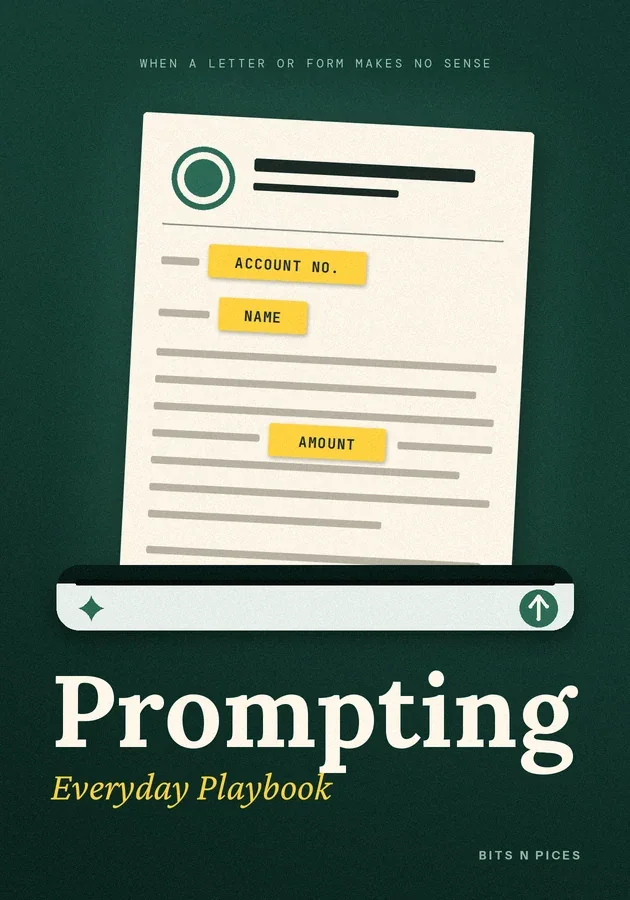
- When a letter or form makes no sense
Trigger: a notice from the housing society, a school admission form or an insurance renewal letter arrives in language nobody at home can decode. The tool is good at plain language, but official papers carry names, addresses, policy numbers and signatures that should not leave the house.
- When your child's prompt goes wrong
Trigger: your child types a question, gets something too hard, too long or beside the point, and announces that the tool is useless. The instinct is to take the keyboard and fix it.
Apprenez-le de six manières
Visualisation, Carte mentale, Pratique, Scénario, Défi et Révision sont disponibles pour ce livre.
Quiz et cartes mémoire
Testez ce que vous avez lu et retenez-le grâce à la répétition espacée.
Bits AI
Il répond sur le livre, la section ou la question de quiz sur laquelle vous vous trouvez.





