

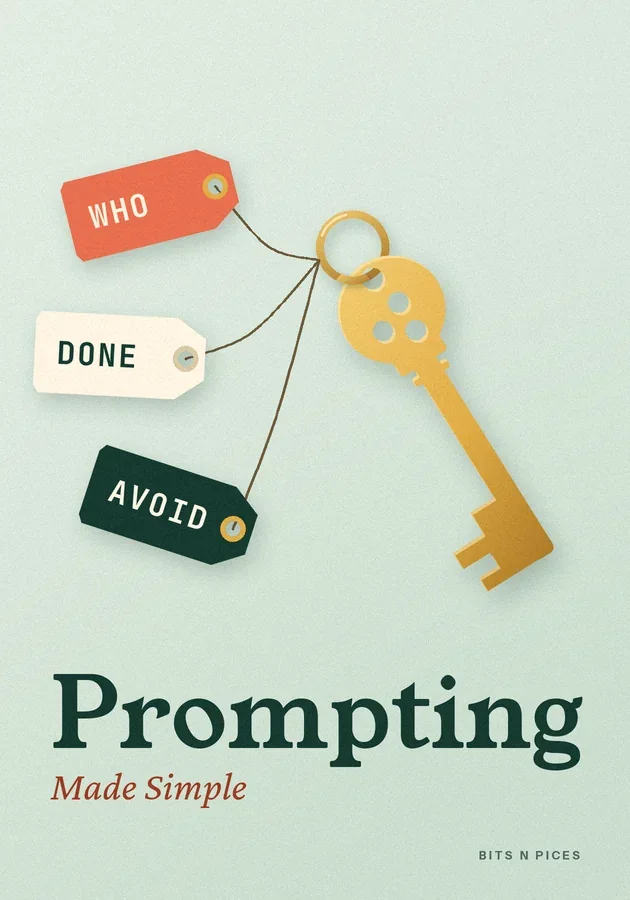
Prompting Made Simple
Points clés
- A prompt is a brief for a capable stranger who knows nothing about your family, so the brief has to carry everything that matters.
- Three questions cover most of the value: who is this for, what does done look like, and what must the answer avoid.
- The same prompt gives different answers because the tool samples from many likely continuations, so pin the parts you care about in writing.
- Long chats drift as early instructions slide out of view; restarting with a fresh, complete brief is faster than arguing with a tired conversation.
- Children learn briefing by watching you do it aloud, so narrate your three questions at the kitchen table before you type anything.
À l'intérieur de ce bit
- The babysitter analogy that explains everything
Imagine a very capable person arrives at your door to look after the children for an evening. They have read a great deal, they are polite, and they have never met your family.
- Three myths that keep parents stuck
The first myth is that there are magic words. Parents swap phrases like "think step by step" as if they were passwords.
- The twenty percent: three questions before you type
Most of the benefit of prompting comes from answering three questions before you type. Who is this for?
- Why the same prompt gives different answers
Parents at an advanced level often notice something unsettling: the same prompt, typed twice, gives two different replies. This is by design.
- Teaching a child to brief, not to beg
Children pick up prompting from watching you, so the most powerful thing you can do is think aloud. Before typing, say the three questions at the table: who is this for, what does done look like, what must it avoid.
- Keeping it simple when the stakes rise
Simple does not mean careless. As families lean on these tools for more, two second-order effects appear.
Apprenez-le de six manières
Visualisation, Carte mentale, Pratique, Scénario, Défi et Révision sont disponibles pour ce livre.
Quiz et cartes mémoire
Testez ce que vous avez lu et retenez-le grâce à la répétition espacée.
Bits AI
Il répond sur le livre, la section ou la question de quiz sur laquelle vous vous trouvez.





