

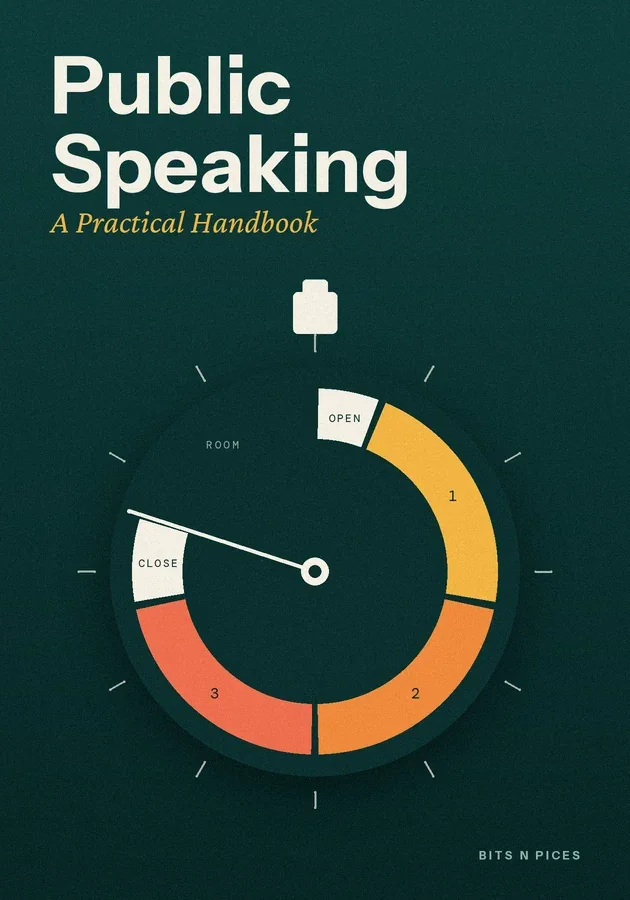
Public Speaking: A Practical Handbook
Points clés
- Plan every talk, yours or your child's, on one sheet: their question, your answer in a sentence, three timed points, exact first and last lines, likely questions.
- Rehearse in pieces before running it whole: the first and last lines, each point against its time budget, then the seams between points, where most stumbles hide.
- Plan to fill about four-fifths of your slot, and when a timed run overruns, cut a whole point rather than speaking faster.
- Sort each question first: answer clarifying ones briefly, meet challenges with acknowledgement and a reason, admit what you do not know, and park off-topic ones.
- After every talk the speaker reviews first, then takes one keep and one change from a listener, so feedback builds skill instead of arguments.
À l'intérieur de ce bit
- The one-page planning sheet
Every talk in your household, whether a work update, a society meeting or a school speech, can be planned on a single sheet with five rows. Row one: who is listening and the question they walk in with.
- Rehearsing in pieces, then the seams
Running a talk from top to bottom again and again spends most of the effort on parts you already know. Rehearse in pieces instead.
- Timing, notes and slides that help
Three tools do most of the practical work. The timer: plan to fill about four-fifths of the slot, because pauses, laughter and a late start stretch every talk on the day.
- A day-of checklist for any stage
Most things that go wrong on the day are logistical, and a checklist catches them. The night before: notes in order, slides saved in two places, clothes chosen, route and timing known.
- Sorting questions before you answer them
Question time gets easier once you notice that questions come in four kinds, each with its own procedure. A clarifying question, such as when does this start, gets a short answer and a check: does that cover it?
- Feedback that improves the next talk
Feedback has a procedure too, and the order matters. The speaker reviews first: what went well, what felt shaky.
Apprenez-le de six manières
Visualisation, Carte mentale, Pratique, Scénario, Défi et Révision sont disponibles pour ce livre.
Quiz et cartes mémoire
Testez ce que vous avez lu et retenez-le grâce à la répétition espacée.
Bits AI
Il répond sur le livre, la section ou la question de quiz sur laquelle vous vous trouvez.





