Storytelling: A Practical Handbook
Points clés
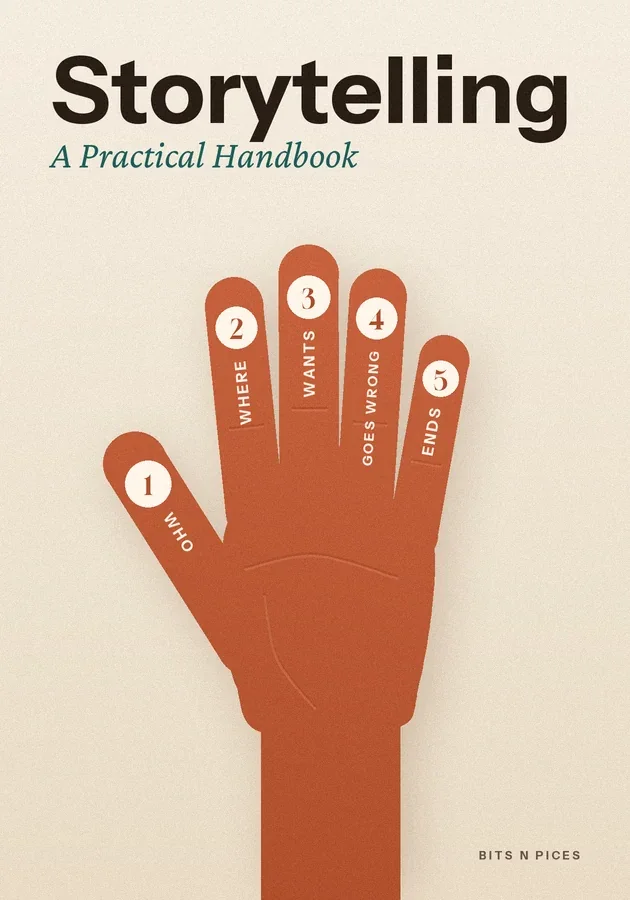
- Plan any story on one hand, who, where, what they want, what goes wrong and how it ends, whether it is for bedtime or a work briefing.
- When you tell a story aloud, give each main character a small voice change, add a refrain your child can join and finish quieter than you started.
- Draw a family story map of numbered places, and let every number hold a story that someone in the family can tell.
- Make folded storybooks in which the child tells and draws while the adult writes down the child's words exactly as spoken.
- Respond to stories with one thing you pictured, one thing you felt and one question, and ask your children to do the same for yours.
À l'intérieur de ce bit
- The one-hand story plan
Every routine in this handbook starts from one tool, and it fits on a hand. The thumb is who the story is about.
- Telling a story aloud: voices, refrains, sounds
A story you know well can still fall flat if it is told in one steady tone. Four small techniques fix that, and none needs acting talent.
- Drawing a family story map
A family story map turns places into stories, and it needs only a large sheet of paper and some pencils. Draw your home in the middle, then add the places your family knows: school, the market, the bus stop, a grandparent's house, the park.
- Making a folded storybook together
A folded storybook turns a spoken story into something a child can hold, reread and give away. Take two sheets of paper, fold them in half together and staple or stitch the fold to make an eight-page booklet.
- Acting it out: the five-minute family play
Acting a story out teaches children what a story needs faster than any explanation, because a play falls apart without a clear want and a clear ending. Keep it to five minutes.
- Feedback that flows both ways
How you respond to a child's story decides whether they tell another. Use a three-part response: one thing I pictured, one thing I felt, one question I have.
Apprenez-le de six manières
Visualisation, Carte mentale, Pratique, Scénario, Défi et Révision sont disponibles pour ce livre.
Quiz et cartes mémoire
Testez ce que vous avez lu et retenez-le grâce à la répétition espacée.
Bits AI
Il répond sur le livre, la section ou la question de quiz sur laquelle vous vous trouvez.