

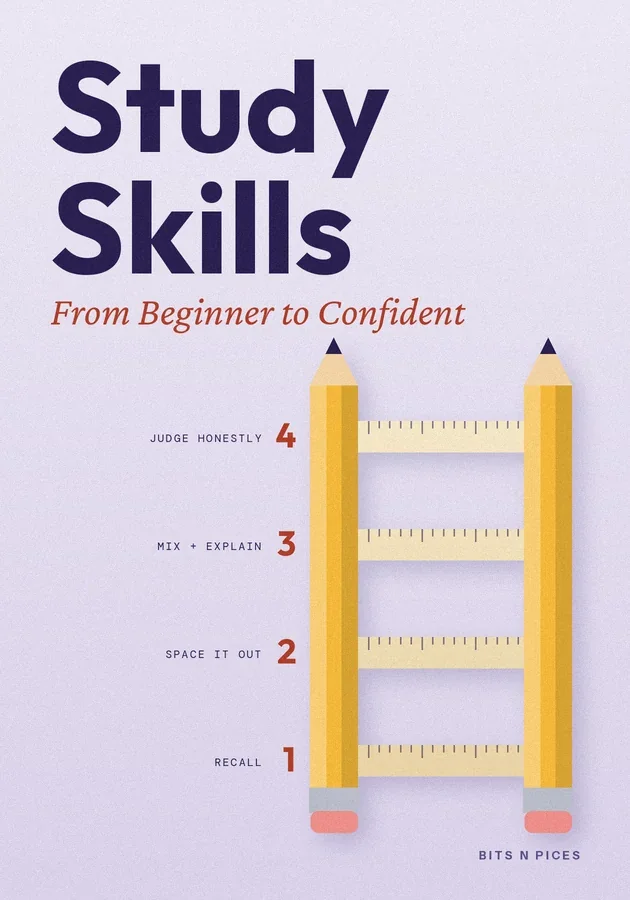
Study Skills: From Beginner to Confident
Points clés
- Before you reread anything, close the book and write what you remember, because the effort of recalling is what makes a memory stick.
- Spread the same study hours across several days with growing gaps: review tomorrow, in three days, next week and about three weeks later.
- Mix different kinds of questions in one sitting and say aloud why each answer works, so you learn to choose a method, not just repeat one.
- Predict your score before every practice quiz, then log each mistake as not knowing, misreading the question or running out of time.
- Move up a rung only when you have evidence, such as older topics holding steady without a cram, not when you simply feel ready.
À l'intérieur de ce bit
- The study ladder and where you stand
Study skills are the methods you use to get knowledge into memory and keep it usable: how you read, practise, plan and check yourself. Most adults were taught subjects at school but never how to learn them, so many of us still study the way we did at fourteen.
- Rung one: close the book and recall
Retrieval practice means pulling information out of your memory rather than pouring it back in. Each time you recall something, even slowly and with gaps, the memory gets stronger and easier to find next time.
- Rung two: let time do some work
Cramming packs all your practice into one long sitting. It can carry you through tomorrow's test, but most of what you crammed fades within days.
- Rung three: mix topics and explain why
Once recall and spacing are routine, the next rung is about understanding. Interleaving means mixing different kinds of problem or topic in one session instead of doing twenty of the same kind in a row.
- Rung four: judge your own learning honestly
Confident learners are not people who always feel sure. They are people whose feeling of sureness matches how they actually perform.
- Proof that you have moved up
Learning progress is slow and uneven, so feeling stuck is common. Look for evidence instead of mood.
Apprenez-le de six manières
Visualisation, Carte mentale, Pratique, Scénario, Défi et Révision sont disponibles pour ce livre.
Quiz et cartes mémoire
Testez ce que vous avez lu et retenez-le grâce à la répétition espacée.
Bits AI
Il répond sur le livre, la section ou la question de quiz sur laquelle vous vous trouvez.





