

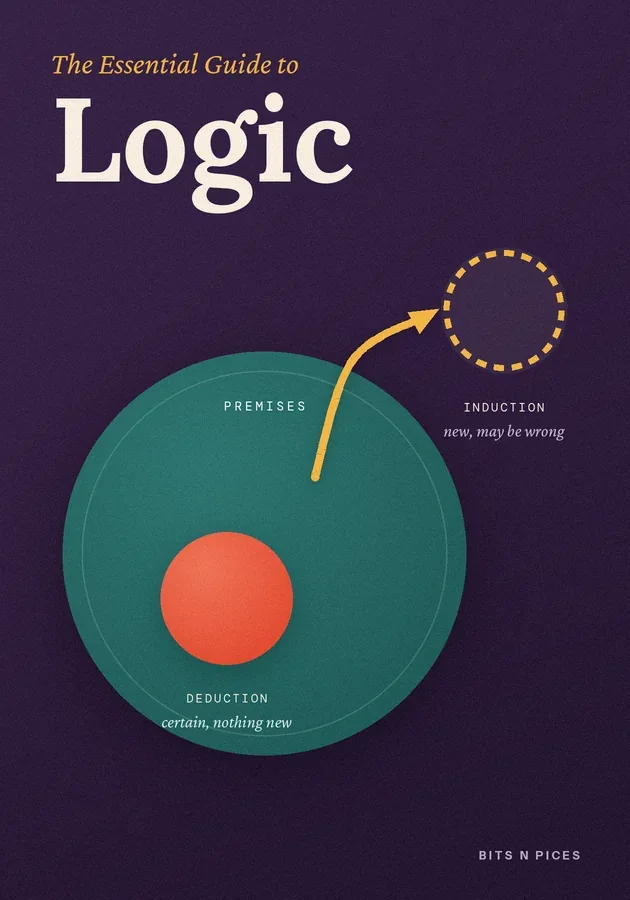
The Essential Guide to Logic
Points clés
- Logic fits on one page: arguments, three ways of supporting them, the ways reasoning fails, and the goal of matching belief to evidence.
- Before judging a claim, ask whether it rests on deduction, induction or explanation, because each has its own test and its own way of failing.
- Deduction is certain but adds nothing new, while induction and explanation add something new but can be wrong, so hold their conclusions provisionally.
- Catch fallacies by checking the argument and counter biases by changing the process, such as keeping a written log instead of trusting memory.
- Start with four habits, find the claim, surface the assumption, apply the right test and match your confidence, and leave fallacy lists for later.
À l'intérieur de ce bit
- The whole map on one page
Logic can look like a sprawling subject full of symbols and Latin names, but its core fits on one page. There are six big ideas.
- Idea one: a claim plus its reasons
An argument, in logic, is not a quarrel. It is a claim, called the conclusion, supported by one or more reasons, called premises.
- Deduction: certainty that comes from form
Deduction is reasoning in which true premises guarantee the conclusion. The guarantee comes from the shape of the argument, not its subject.
- Induction and explanation: reasoning without guarantees
Most real decisions rest on reasoning that cannot guarantee its conclusion. Induction moves from observed cases to a general pattern or a prediction, and its strength depends on how many cases you saw and how varied they were.
- Fallacies and biases: how reasoning fails
A fallacy is a flaw in an argument, a pattern that looks like good reasoning but is not. Four turn up constantly.
- What to prioritise and what to ignore
Beginners often start in the wrong place. Long lists of fallacy names, symbols such as arrows and upside-down letters, and the art of winning debates are all real parts of logic, and all of them can wait.
Apprenez-le de six manières
Visualisation, Carte mentale, Pratique, Scénario, Défi et Révision sont disponibles pour ce livre.
Quiz et cartes mémoire
Testez ce que vous avez lu et retenez-le grâce à la répétition espacée.
Bits AI
Il répond sur le livre, la section ou la question de quiz sur laquelle vous vous trouvez.





