

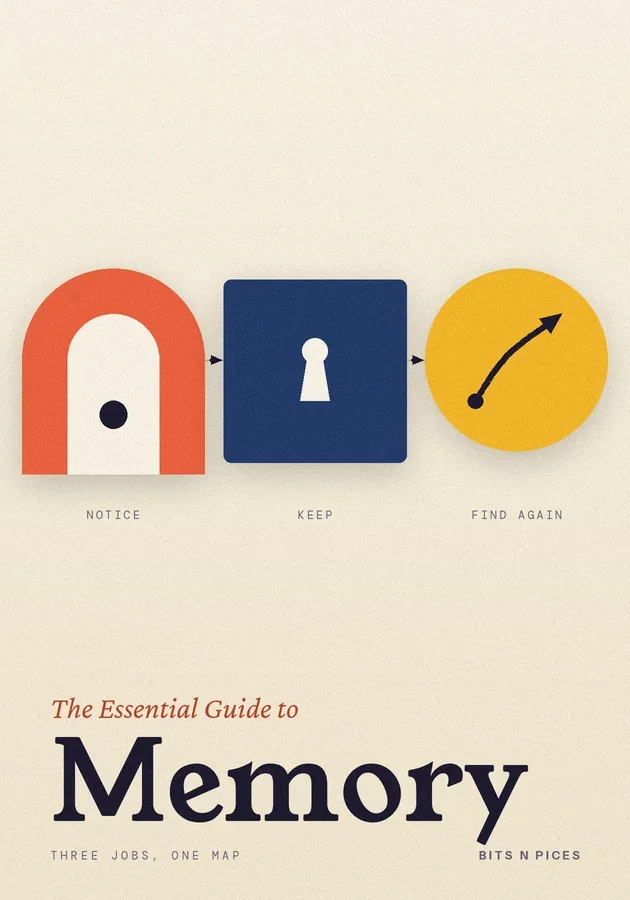
The Essential Guide to Memory
Points clés
- Memory is three jobs, noticing, keeping and finding again, so when something slips, ask which of the three actually failed before choosing a fix.
- Attention is the gate: anything you half-notice while a phone buzzes was never properly stored, so give new material a few undivided minutes.
- Link every new fact to something you already know, a place, a person or a reason, because connected memories come with more ways back in.
- Close the notes and pull the answer out of your head, because each effortful recall strengthens a memory far more than another read-through.
- Review just as you start to forget, in short sessions spread over days, and let sleep and simple written lists carry the rest of the load.
À l'intérieur de ce bit
- The map: memory as three jobs
Memory is not a single box in your head. It is three jobs done one after another.
- Attention: the gate everything passes through
Nothing reaches long-term memory without passing through attention first. Working memory, the desk where you hold whatever you are thinking about right now, is small; a common estimate is about four chunks at once.
- Meaning: why connected facts stay
Memories are stored in webs, not piles. A new fact that links to things you already know gets more threads attached, and every thread is another route back to it later.
- Retrieval: remembering is what strengthens memory
Here is the idea that surprises most people: recalling something is not just a check on memory, it changes memory. Each time you pull a fact out of your head without looking, the route to it gets stronger.
- Spacing: working with forgetting, not against it
Forgetting is not a fault; it is how memory keeps itself useful. Anything you do not revisit fades, quickly at first and then more slowly, a pattern often drawn as a forgetting curve.
- Support, priorities and what to ignore
Three supports carry the other ideas. Sleep is when the brain sorts and strengthens the day's learning, so a night of cramming can cost the very memories it was meant to build.
Apprenez-le de six manières
Visualisation, Carte mentale, Pratique, Scénario, Défi et Révision sont disponibles pour ce livre.
Quiz et cartes mémoire
Testez ce que vous avez lu et retenez-le grâce à la répétition espacée.
Bits AI
Il répond sur le livre, la section ou la question de quiz sur laquelle vous vous trouvez.





