

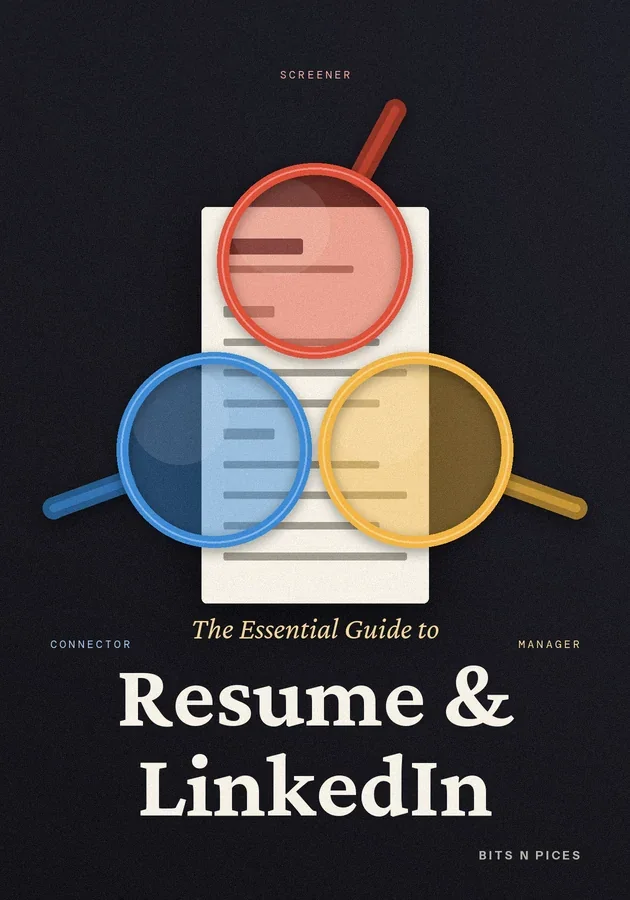
The Essential Guide to Resume & LinkedIn
Points clés
- Write for three readers at once: the screener checking the match, the manager judging how you work, and the connector who might introduce you.
- Choose your structure on purpose: chronological when recent roles match the target, a hybrid block when your best evidence sits elsewhere.
- Back important claims with a mix of numbers, artefacts and other people's words, and say we for team wins and I for your part.
- Treat your profile as a meeting place: fewer, real connections and a three-sentence forwardable blurb make introductions easy.
- Match your visibility to your goal, and ignore any advice that helps no reader, such as fancy templates, match scores and endorsement counts.
À l'intérieur de ce bit
- Three readers, three questions
Every resume and profile is read by at least three kinds of people, and each asks something different. The screener, often a recruiter juggling many roles, asks whether you match: the right kind of experience, the right level, the right place.
- Structure is a strategic choice
Most resumes use reverse-chronological order: latest role first, each with dates and results beneath. It suits anyone whose recent roles point at the target, and most readers expect it.
- Proof comes in three currencies
Claims persuade only when something backs them, and proof comes in three currencies. Numbers are the first: volumes, speed, money, error rates, before and after.
- The profile is a meeting place
A resume waits in an inbox; a profile sits inside a network, and that changes what it is for. Much of its value comes not from strangers finding you but from people who already half-know you: a former colleague who notices your new headline, a friend's manager who looks you up before an introduction.
- How visible to be, and when
LinkedIn offers a spectrum of visibility, from a quiet, complete profile to regular posting, and each point on it has a cost. Silence costs nothing but leaves anyone who looks you up with only the static page.
- What to prioritise and what to ignore
The five ideas fit together in order. Knowing your three readers tells you what each part of the page must do.
Apprenez-le de six manières
Visualisation, Carte mentale, Pratique, Scénario, Défi et Révision sont disponibles pour ce livre.
Quiz et cartes mémoire
Testez ce que vous avez lu et retenez-le grâce à la répétition espacée.
Bits AI
Il répond sur le livre, la section ou la question de quiz sur laquelle vous vous trouvez.





