

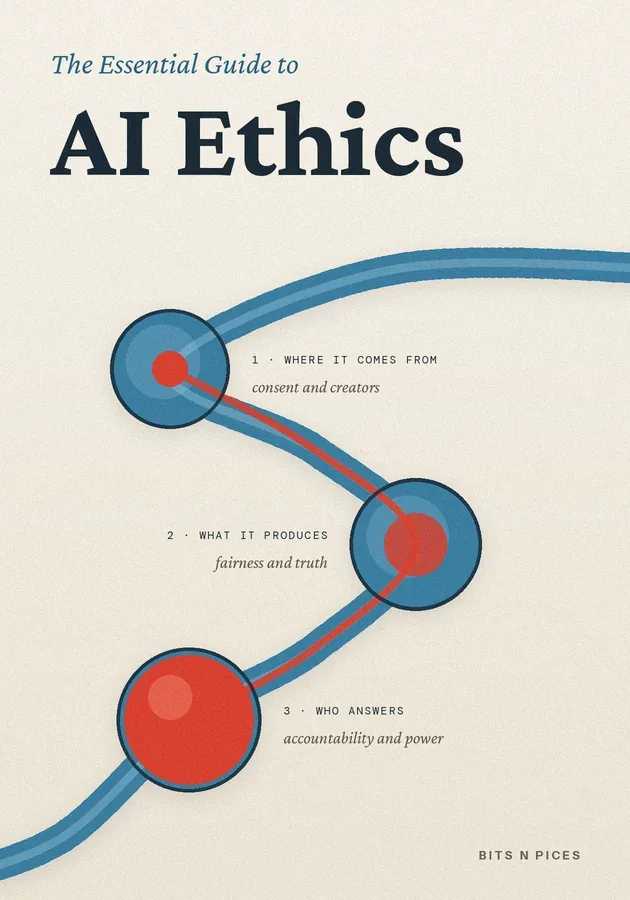
The Essential Guide to AI Ethics
Poin penting
- AI ethics fits on one map with three stages: where a system comes from, what it produces, and who answers for it.
- Problems travel downstream, so a shortcut on consent in the data later turns up as an unfair or untrue output someone must answer for.
- Unfair outputs and untrue outputs share one root, a model repeating patterns, so check results against reality instead of trusting fluent answers.
- Every answer carries hidden costs in electricity, water and human labour, so use AI where it adds real value rather than for throwaway output.
- Give your attention first to systems that touch livelihoods, health, education or freedom, and let speculation about conscious machines wait.
Di dalam bit ini
- The whole field on one page
AI ethics can feel like an endless list of worries, but it fits on one map with three stages. The first is where a system comes from: whose data and whose work it learned from, and what it cost to build.
- Where it comes from: consent and creators
Every AI system starts with material: text, photos, recordings and clicks, gathered in huge quantities. Much of it was collected by scraping, which means software automatically copying pages from the web.
- What it produces: fairness and truth
Outputs are where most people meet AI ethics, and the two big ideas here share a root. A model learns patterns and repeats them.
- The hidden costs behind every answer
The second idea at the input stage is cost, and much of it is out of sight. Large models are trained and run in data centres, buildings packed with computers that draw a great deal of electricity and, in some places, large amounts of water for cooling.
- Who answers: accountability and power
The last stage asks who stands behind a system. Accountability means a named person or organisation answers for a result: they can explain the reasons, correct mistakes and hear an appeal.
- Trade-offs, priorities and what to ignore
The six ideas often pull against each other, and naming the trade-off is most of the work. Convenience competes with consent: the most helpful assistant wants the most data.
Pelajari dengan enam cara
Visualisasi, Peta Konsep, Latihan, Skenario, Tantangan, dan Ulasan tersedia untuk buku ini.
Kuis dan flashcard
Uji apa yang kamu baca dan ingat terus dengan pengulangan berjarak.
Bits AI
Menjawab tentang buku, bagian, hingga pertanyaan kuis yang sedang kamu kerjakan.





