

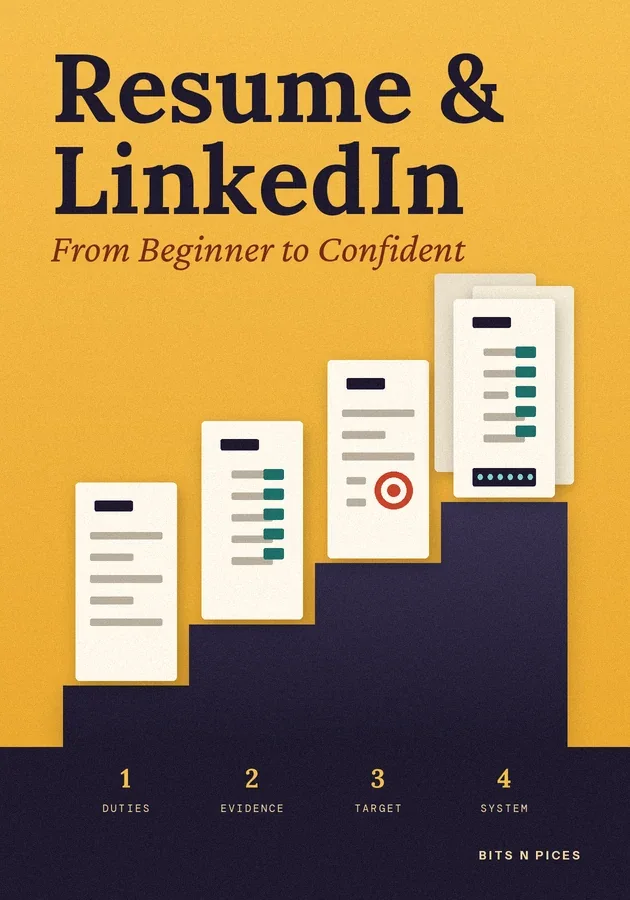
Resume & LinkedIn: From Beginner to Confident
重要なポイント
- Every resume line should survive a follow-up question, so write evidence you can explain for two minutes rather than claims you hope nobody tests.
- Aim each version at one target role; a resume built to fit three different jobs reads as belonging to someone else's search every time.
- Treat your LinkedIn profile as a second witness that agrees with the resume on every fact while adding voice, context and proof.
- Run every application through the same system, a master file, a tailored cut and a line in a log, so you learn which versions earn replies.
- Measure your level by replies per ten tailored applications and by interviewers asking about the bullets you chose, not by how polished the page looks.
このbitの内容
- Four rungs and how to find yours
Most people climb the same four rungs with their resume and profile, usually without noticing. On rung one, the lister, the document is a record of duties: responsible for reports, handled customer queries.
- Rung two: turning duties into evidence
The move from lister to evidencer is a change of question. Instead of asking what you were responsible for, ask what was different because you were there.
- Rung three: choosing a target and holding it
Positioning means deciding what you want to be hired for and letting that decision edit everything. The summary names the role.
- Your profile as the second witness
Once a recruiter likes your resume, they often look you up, and your profile either confirms the story or quietly contradicts it. Job titles, employers and dates must match the resume exactly, because a mismatch reads as carelessness or concealment.
- Rung four: running a system, not a document
Operators do not edit last year's resume at midnight. They keep a master file, a long private document holding every role, project, result and number they could ever use, updated whenever something worth remembering happens.
- Deliberate practice and proof you have moved up
Reading advice does not move you up a rung; targeted repetitions do. Pick your weakest line and rewrite it three ways: once with a number, once with scale, once with a before-and-after.
6つの方法で学ぶ
この本のために、Visualize、Mind Map、Practice、Scenario、Challenge、Reviewが用意されています。
クイズとフラッシュカード
読んだ内容をテストし、間隔反復で記憶に定着させましょう。
Bits AI
あなたが読んでいる本、セクション、クイズの質問について答えます。





