

重要なポイント
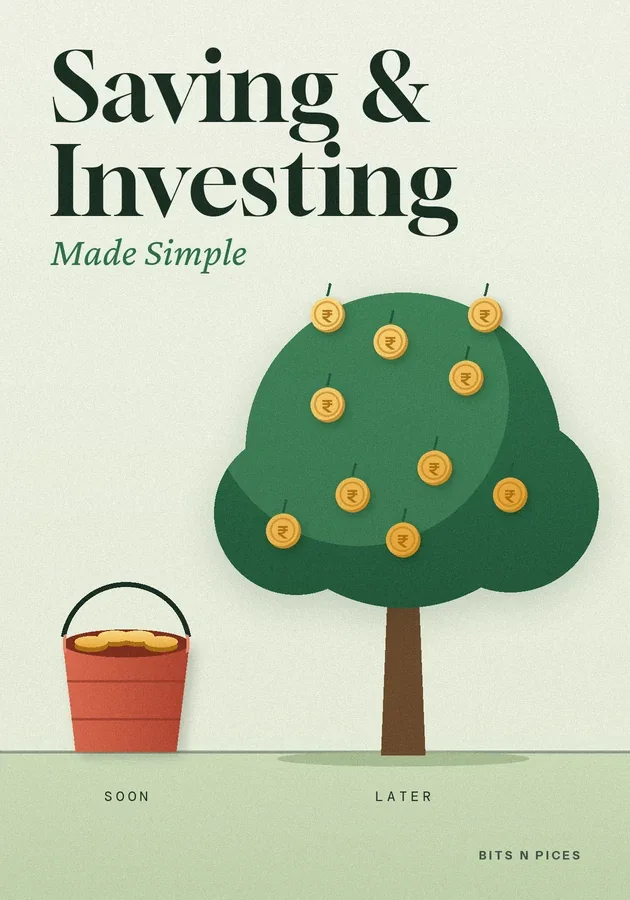
- Saving is a bucket for money you will need soon; investing is a tree for money you can leave alone for many years.
- Compound growth rewards time more than size, so a small amount started early can outgrow a larger amount started years later.
- Pay yourself first with an automatic transfer on payday, because saving whatever is left at the end of the month rarely leaves anything.
- Any offer promising both safety and very high returns is a warning sign, because higher returns always come with higher risk.
- A short monthly family money chat and three simple jars teach children more about money than any lecture you could give.
このbitの内容
- It is simpler than it looks
If money talk makes you want to change the subject, you are in good company. Much of the confusion is noise: new products, clever names, urgent headlines.
- A bucket for soon, a tree for later
Saving and investing sound alike but do different jobs. Saving is a bucket: you fill it with water you will need soon, and you want it exactly where you left it.
- The snowball that does the heavy lifting
Compound growth is the most useful idea in this book, and it fits in one sentence: money earns a little, and then that little earns too. Picture a snowball rolling downhill.
- Five myths that keep families stuck
Myth one: you need a lot of money to start. Small regular amounts, started early, matter more than a lump sum you are still waiting for.
- The few moves that do most of the work
If you remember nothing else, remember four moves. First, pay yourself first: set an automatic transfer on payday, even a small one, so saving happens before spending can reach it.
- Bringing the whole family along
Children learn money more from routines than from lectures. A monthly fifteen-minute family money chat works well: one thing that went well, one surprise and one choice for next month.
6つの方法で学ぶ
この本のために、Visualize、Mind Map、Practice、Scenario、Challenge、Reviewが用意されています。
クイズとフラッシュカード
読んだ内容をテストし、間隔反復で記憶に定着させましょう。
Bits AI
あなたが読んでいる本、セクション、クイズの質問について答えます。





