

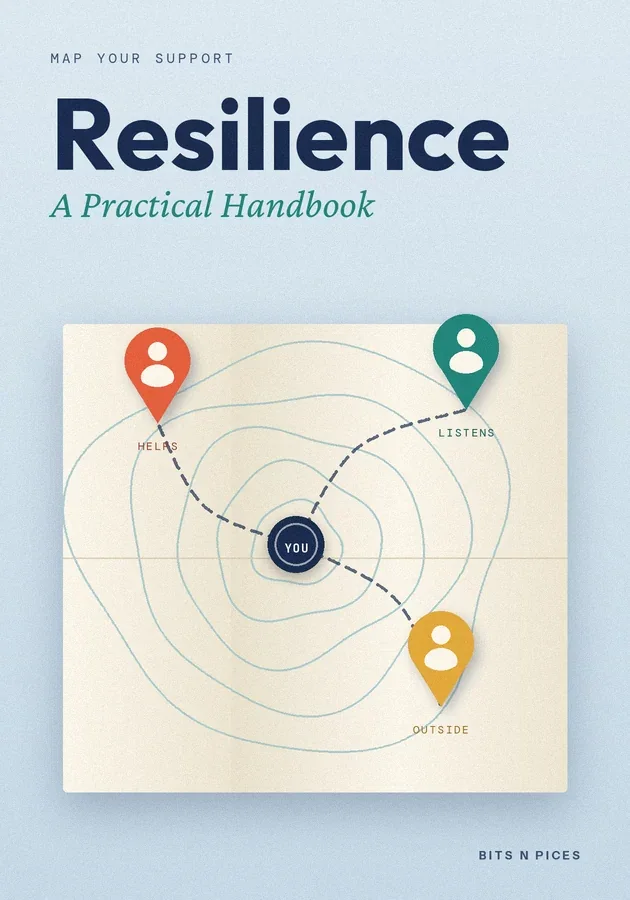
Resilience: A Practical Handbook
Главные выводы
- Run a four-question debrief after a setback once feelings have cooled: what happened, what was in our control, what we learned, what comes next.
- A fifteen-minute weekly family check-in, with a no-fixing rule unless someone asks, builds the habit of talking about hard things early.
- Ask your child whether they want help or just want you to listen before offering solutions, and repair quickly when you get it wrong.
- Draw a support map for yourself and each child, naming who helps practically, who listens and which trusted adults sit outside the family.
- In heavy weeks, cut down to a short list of basics and drop or delay the rest, because lowering standards for a while is a strategy.
Внутри этого бита
- The four-question setback debrief
A debrief turns a painful event into something your family can learn from, and it works for adults and children alike. Use four questions: What happened?
- A fifteen-minute weekly family check-in
Resilient families talk about difficulty before it becomes a crisis, and a weekly check-in makes that routine. Attach it to a time that already exists, such as Sunday dinner or a Saturday drive, and keep it to fifteen minutes.
- Scripts for the hard moments
Hard moments move fast, so it helps to have words ready. When a child comes home upset, the most useful first line is often a question: 'Do you want help with this, or do you want me to just listen?
- Drawing a support map
Resilience leans heavily on other people, yet most parents have never looked at their support network on paper. A support map takes ten minutes.
- The heavy-week checklist
Some weeks will not bend: a relative in hospital, a crisis at work, exams, a house move. A parent's resilience in those weeks depends less on willpower and more on what you stop doing.
- Struggle or step in: making the call
Children build resilience by meeting difficulty they can manage with some support. If adults remove every obstacle, children miss the practice; if adults step too far back, children can feel alone.
Изучайте шестью способами
Для этой книги доступны режимы: Визуализация, Интеллект-карта, Практика, Сценарий, Вызов и Повторение.
Тесты и карточки
Проверяйте прочитанное и запоминайте с помощью интервального повторения.
Bits AI
Отвечает на вопросы о книге, разделе или вопросе теста, который вы сейчас проходите.





