

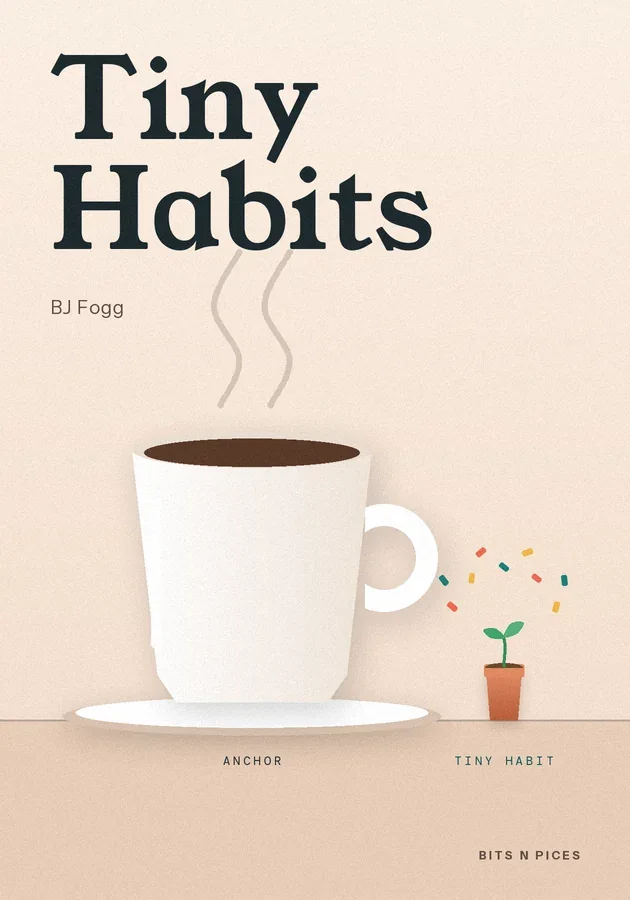
Tiny Habits
Önemli çıkarımlar
- Behaviour happens when motivation, ability and a prompt come together at once
- Make the habit so small that you can do it even on your worst day
- Anchor a new habit right after something you already do every day
- Celebrate immediately, because emotion is what wires a habit into place
- Design your environment instead of relying on willpower or motivation
Bu bit'in içinde
- Change is easier when it is tiny
BJ Fogg, a Stanford behaviour scientist, once decided to do 2 push-ups every time he went to the bathroom. It sounds silly, but within months he was doing dozens a day without effort.
- The behaviour equation
Fogg's central model says a behaviour happens when 3 things line up at the same moment: motivation, ability and a prompt. He writes it as B equals MAP.
- Shrink it until it is easy
Fogg suggests two ways to make any behaviour tiny. Either take a starter step, like putting on your running shoes rather than running, or scale down the whole thing, like flossing 1 tooth instead of all of them.
- Anchor it to something you already do
A new habit needs a reliable prompt, and Fogg says the best prompt is a behaviour already in your life. He calls this an anchor.
- Celebrate to wire it in
This is the part most habit advice misses. Fogg argues that habits form through emotion, not repetition alone.
- Put it to work
This week, choose one habit you want and shrink it until it takes under 30 seconds, like 1 push-up or writing 1 sentence. Find an anchor by listing 5 things you already do every day and picking the one that happens in the right place and at the right time.
Altı farklı yolla öğren
Görselleştir, Zihin Haritası, Pratik, Senaryo, Meydan Okuma ve Tekrar, bu kitap için yazıldı.
Sesli Anlatım
Michael veya Bella tarafından okunan bu biti dinle.
Test ve bilgi kartları
Okuduklarını test et ve aralıklı tekrar ile aklında tut.
Bits AI
Kitap, bölüm ve o an üzerinde olduğun test sorusu hakkında cevaplar verir.





