

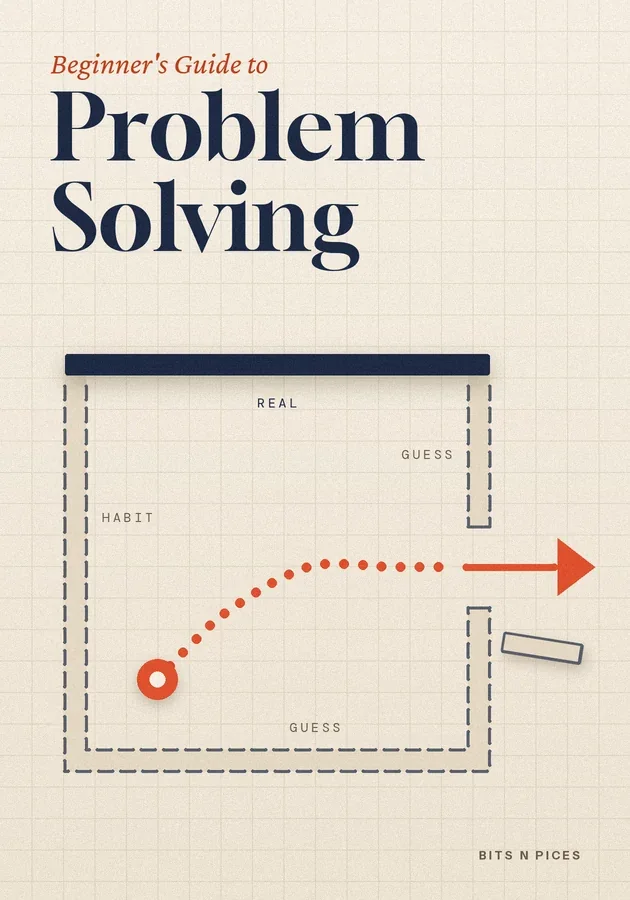
Beginner's Guide to Problem Solving
Những bài học chính
- Worry asks the same question over and over; problem solving turns it into a smaller question you can actually act on today.
- Name the kind of problem first: fix-it, choice, design or people, because each one starts with a different question.
- List the walls around a problem and test each one; many turn out to be habits or guesses rather than real limits.
- When stuck, sketch the problem on paper, flip it by asking how to make it worse, and borrow from someone who solved something similar.
- Before doing a plan for real, walk it through step by step, asking what happens next, to find the weak step while it is cheap to fix.
Bên trong bit này
- What problem solving is, and what it is not
A problem is any situation where you know roughly where you want to be but not yet how to get there. Problem solving is the skill of finding that route on purpose.
- Four kinds of problem, four first questions
Problems come in different shapes, and beginners often reach for the wrong tool because they have not named the shape. A fix-it problem is something that used to work and has stopped; start by asking what changed.
- Walls: which limits are real
Every problem sits inside walls, and testing them is a core beginner skill. A constraint is a real limit you must respect, such as a law, an agreed budget or the size of a room.
- Your first three moves: sketch, flip, borrow
When a problem feels stuck, three beginner moves get it moving. Sketch it: draw the problem as a map, a timeline or a row of boxes, because paper shows patterns that a worried mind cannot hold at once.
- Walk it through before you do it
A plan that looks tidy on paper often fails at one small step nobody pictured. The cheapest way to find that step is a walk-through: go through the plan in order, aloud or on paper, and at every step ask what happens next and what could get in the way.
- Classic beginner mistakes, and the move that fixes each
Most beginner mistakes are one of the moves in this guide, skipped. Treating a people problem as a fix-it problem, such as buying a new rota app when two colleagues simply want different shifts, misses what each person needs.
Học theo sáu cách
Trực quan hoá, Sơ đồ tư duy, Thực hành, Tình huống, Thử thách và Ôn tập được viết riêng cho cuốn sách này.
Trắc nghiệm và flashcard
Kiểm tra những gì bạn đã đọc và ghi nhớ lâu hơn với lặp lại ngắt quãng.
Bits AI
Trợ lý này trả lời dựa trên cuốn sách, phần học, hay câu trắc nghiệm mà bạn đang làm.





