

Beginner's Guide to Stress Management
Những bài học chính
- Stress is your body mobilising to meet a demand; the trouble starts when that mobilisation keeps running without enough recovery afterwards.
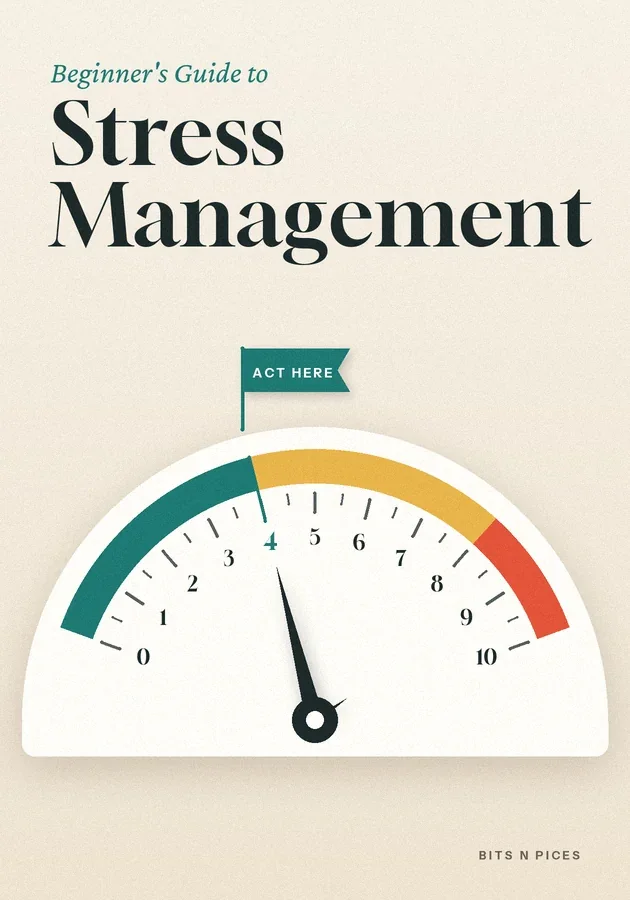
- Learn your personal stress signature, the body, thought and behaviour signals that show up first, so you can act at four out of ten, not nine.
- Sort every worry into what you control, what you can influence and what you cannot change, then spend your effort on the first two.
- When a problem can be changed, solve it; when it cannot, soothe your body and attention, because using the wrong tool keeps stress going.
- Ask for specific help early, and see a doctor or counsellor when stress stays heavy for weeks or starts affecting sleep, work or relationships.
Bên trong bit này
- What stress actually is
Stress is the name we give to your body and mind gearing up to meet a demand. The demand is called a stressor: a deadline, an argument, a noisy flat, a bill that arrived early.
- The vocabulary that makes stress workable
A few terms turn a vague feeling into something you can work with. A stressor is the event or condition that makes a demand on you.
- Reading your own early signals
Everyone has a stress signature, a personal set of signals that appear before things get serious. Some show up in the body: a tight jaw, shallow breathing, a knot in the stomach, a headache by late afternoon.
- Your first three moves
Once you can spot stress rising, three moves cover most everyday situations. The first is to sort.
- Beginner mistakes that keep stress going
The first classic mistake is using the wrong tool. If your stress comes from a problem you could fix, such as an unanswered message from your landlord, breathing exercises only postpone it.
- Talking about it and knowing when to get help
Stress shrinks when it is shared well. Vague complaints such as 'everything is too much' leave people unsure how to help.
Học theo sáu cách
Trực quan hoá, Sơ đồ tư duy, Thực hành, Tình huống, Thử thách và Ôn tập được viết riêng cho cuốn sách này.
Trắc nghiệm và flashcard
Kiểm tra những gì bạn đã đọc và ghi nhớ lâu hơn với lặp lại ngắt quãng.
Bits AI
Trợ lý này trả lời dựa trên cuốn sách, phần học, hay câu trắc nghiệm mà bạn đang làm.





