

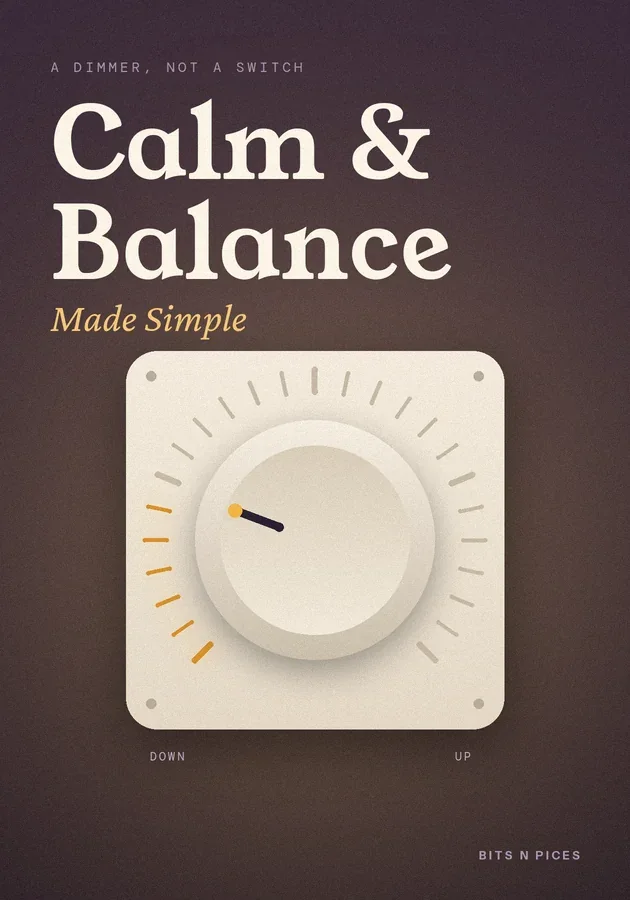
Calm & Balance Made Simple
Những bài học chính
- Calm works like a dimmer, not a switch: the goal is to turn your stress down sooner, not to never feel it at all.
- Children learn calm mostly by watching you settle, so a visible slow breath teaches more than any instruction to calm down.
- A few moves do most of the work: breathe out slowly, lower your voice and body, and name the feeling in few words.
- Treat energy like a phone battery: notice what drains the family each day and add small recharges before everyone hits empty.
- When you lose your temper, come back and repair it, and if worries about a child persist, talk to their teacher or doctor.
Bên trong bit này
- Calm works like a dimmer, not a switch
Many parents picture calm as an on-off switch: either you are the endlessly patient parent from an advert, or you are shouting on the stairs. A more useful picture is a dimmer.
- Five myths that keep parents wound up
Myth one: a calm parent never gets angry. In reality, calm parents get angry and come back sooner.
- The family battery: what drains and what charges
Think of each person in your home as carrying a phone battery. Some things drain it: rushing, noise, hunger, late-night screens and too many decisions.
- The few moves that do most of the work
You do not need a shelf of techniques. Three moves cover most moments at home.
- Showing calm so children can copy it
Children learn far more from what they watch you do than from what you tell them. If you say 'breathe' while shouting, they learn the shouting.
- When simple is not enough
Simple moves handle everyday stress, but they are not meant for everything. Part of good judgement is noticing when a pattern is bigger than a bad week.
Học theo sáu cách
Trực quan hoá, Sơ đồ tư duy, Thực hành, Tình huống, Thử thách và Ôn tập được viết riêng cho cuốn sách này.
Trắc nghiệm và flashcard
Kiểm tra những gì bạn đã đọc và ghi nhớ lâu hơn với lặp lại ngắt quãng.
Bits AI
Trợ lý này trả lời dựa trên cuốn sách, phần học, hay câu trắc nghiệm mà bạn đang làm.





