

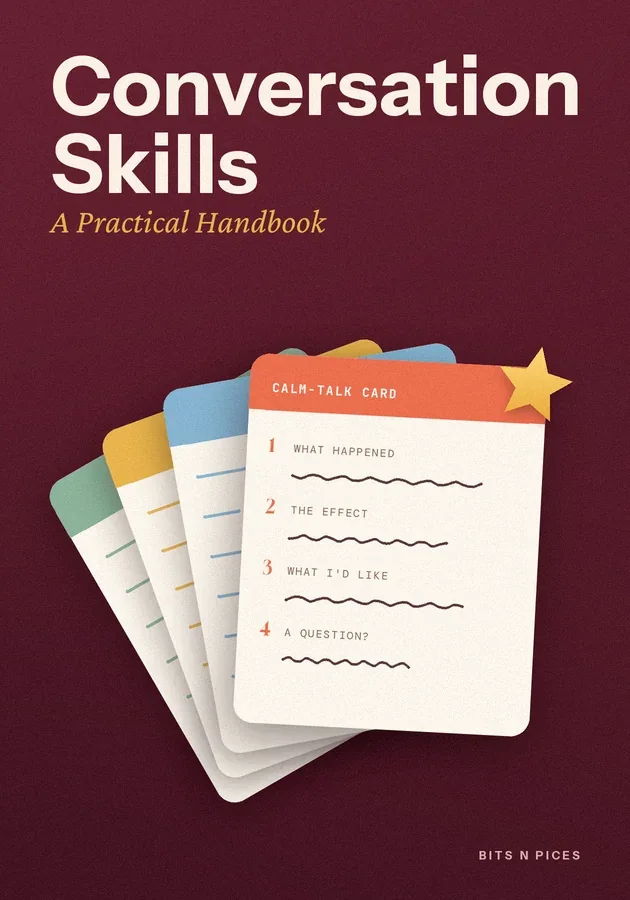
Conversation Skills: A Practical Handbook
Những bài học chính
- Meet anyone new in three parts: your name, your link to the place or person, and one open question tied to that link.
- Write a swap list of your five most-used questions and rewrite each as a specific what or how question, dropping the why.
- Put the headline first when you need something: the point, one reason, a specific ask, and a check that confirms the next step.
- Before a difficult talk, write four lines on a card, what happened, the effect, what you would like and a question, then choose a private moment.
- Rehearse real conversations as a family for ten minutes one evening a week, swapping roles, and give feedback as one star and one step.
Bên trong bit này
- The name-link-question opener
Most people freeze when meeting someone new because they do not know what to say first. The name-link-question opener gives you the first ten seconds every time.
- The question swap list for better answers
Some questions are built to get one-word answers. How was school gets fine.
- Headline first: a template for asking clearly
Many requests fail because the point arrives last, after a long story the listener has stopped following. Headline first fixes this with a four-part template you can write on a card.
- Voice, pace and face: a delivery checklist
The same words can land as calm or as a telling-off depending on how they are said. Tone is the feeling carried by your voice, and listeners pick it up before they have processed your words.
- The calm-talk card for difficult conversations
A difficult conversation is any talk where feelings are strong, views differ and something matters. Four lines prepared on a card keep you steady.
- Family role-play and the star-and-step review
Skills grow with practice and honest feedback, and a family can supply both in ten minutes a week. On one set evening, every person names one real conversation coming up: asking a shopkeeper to exchange shoes, joining a game at the park, asking a manager for a shift swap.
Học theo sáu cách
Trực quan hoá, Sơ đồ tư duy, Thực hành, Tình huống, Thử thách và Ôn tập được viết riêng cho cuốn sách này.
Trắc nghiệm và flashcard
Kiểm tra những gì bạn đã đọc và ghi nhớ lâu hơn với lặp lại ngắt quãng.
Bits AI
Trợ lý này trả lời dựa trên cuốn sách, phần học, hay câu trắc nghiệm mà bạn đang làm.





