Decision Making: From Beginner to Confident
Những bài học chính
- Decision confidence means trusting how you decide rather than feeling sure of the result, and it grows in stages you can practise one at a time.
- If you often let deadlines pass or say 'whatever you think', make three tiny timed decisions a day to rebuild the habit of choosing.
- Before any choice made while tired, hungry, rushed or upset, pause long enough to name two options and one reason for each.
- For choices that matter, write your criteria and their weights before scoring any option, and treat the total as a thinking aid, not a verdict.
- Keep a simple decision log for a month and review it weekly, because your patterns show which stage you are on and what to practise next.
Bên trong bit này
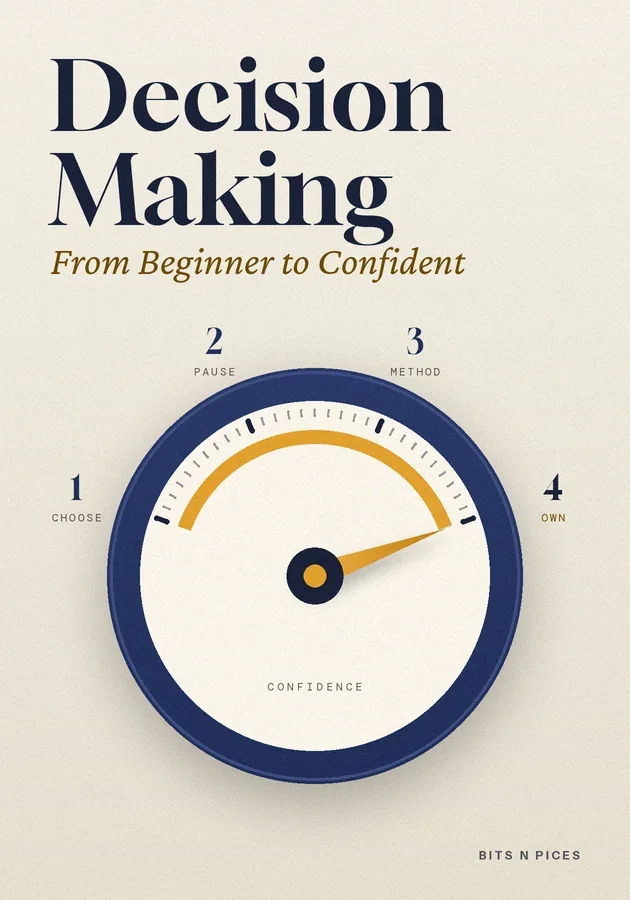
- The four stages of decision confidence
A decision is simply a choice between two or more options, and choosing one usually means giving something up. That giving up is called a trade-off.
- Stage one: from drifting to choosing
At the drifting stage, decisions are made by default. A default is what happens when you do not choose: the deadline passes, someone else decides, or things simply carry on as they are.
- Stage two: from snap judgements to a pause
At the snapping stage you do decide, but fast and on feeling. A snap judgement is a choice made in the heat of the moment without looking at other options.
- Stage three: from gut feel to a method
At the weighing stage you use a method instead of a mood. The most useful beginner method is a weighted list.
- Stage four: the right speed, then ownership
At the owning stage the method becomes flexible. You decide small, reversible choices quickly and give big, hard-to-undo ones real time.
- Practising on purpose and spotting progress
Climbing the ladder takes deliberate practice, which means working on one specific skill on purpose and checking how it went, rather than just making lots of decisions. The simplest tool is a decision log: a notebook page with four columns for the decision, the options, your reason and what happened.
Học theo sáu cách
Trực quan hoá, Sơ đồ tư duy, Thực hành, Tình huống, Thử thách và Ôn tập được viết riêng cho cuốn sách này.
Trắc nghiệm và flashcard
Kiểm tra những gì bạn đã đọc và ghi nhớ lâu hơn với lặp lại ngắt quãng.
Bits AI
Trợ lý này trả lời dựa trên cuốn sách, phần học, hay câu trắc nghiệm mà bạn đang làm.