

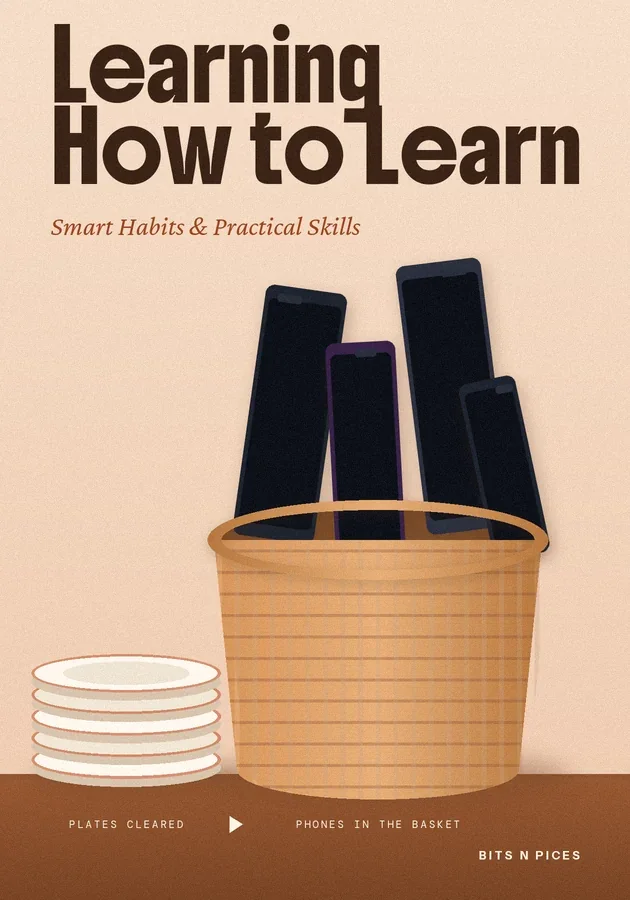
Learning How to Learn: Smart Habits & Practical Skills
Những bài học chính
- Run learning on a small daily system and do some learning yourself at the same table, because children copy the routine they see.
- Anchor the session to an event that happens every day, such as clearing the dinner plates, because clock times break on irregular schedules.
- Make starting effortless and drifting awkward, and put your own phone in the basket too, since children follow the rules adults visibly keep.
- Log mistakes fixed rather than hours studied, and praise the strategy your child used rather than their talent, so attention stays on the process.
- Agree a floor version and a restart ritual before busy seasons, and hand teenagers the design of their own system while you act as consultant.
Bên trong bit này
- Systems that outlast motivation
Most family learning runs on bursts: a determined Sunday, a panicked night before an exam, a resolution after a bad report. Bursts tend to produce results that fade within weeks.
- Cues that start the session without nagging
A cue is whatever tells the brain it is time to begin. Most families use the weakest cue available, a parent's voice, which turns every session into a negotiation.
- Friction: make starting easy and drifting hard
Friction is the small effort that stands between you and an action. Good habit design lowers it for learning and raises it for distraction.
- Tracking and rewards that keep attention on learning
What you track shapes what your family does, so choose carefully. Tracking hours invites padding: a child can sit for forty minutes and learn little.
- Conversations that teach children how learning works
The words you use at home teach children what learning is. Praise that names a talent, 'you are so clever', tells them success is fixed, so a hard problem becomes a threat.
- Keeping it going through busy seasons
Family routines rarely fail on an ordinary Tuesday. They fail in exam weeks, festival holidays, a house move or the arrival of a baby, and they tend to decay quietly, then all at once.
Học theo sáu cách
Trực quan hoá, Sơ đồ tư duy, Thực hành, Tình huống, Thử thách và Ôn tập được viết riêng cho cuốn sách này.
Trắc nghiệm và flashcard
Kiểm tra những gì bạn đã đọc và ghi nhớ lâu hơn với lặp lại ngắt quãng.
Bits AI
Trợ lý này trả lời dựa trên cuốn sách, phần học, hay câu trắc nghiệm mà bạn đang làm.





