

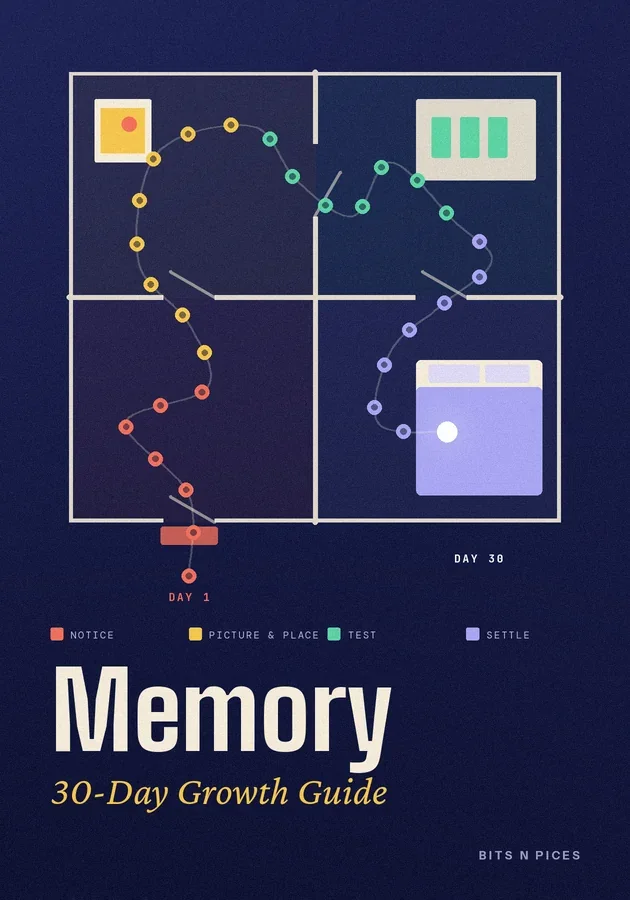
Memory: 30-Day Growth Guide
Những bài học chính
- Take the same short memory test on day one and day thirty, because a real before-and-after beats any feeling of improvement.
- Most forgetting happens at the door, not in storage: if you never paid attention to a name, there is nothing there to recall.
- Turn anything you must remember into a vivid, active picture and place it somewhere familiar, such as a stop along a route through your home.
- Test yourself instead of rereading, and space the tests out: the next day, a few days later, then about a week later.
- When a week slips, resume at the week you left with a smaller daily action rather than restarting the whole programme.
Bên trong bit này
- How the thirty days work
Memory is not one thing but three jobs done in sequence. First you take information in, which researchers call encoding.
- Week one: noticing on purpose
The first week trains encoding, because you cannot recall what never went in. Much of what we call a bad memory is simply divided attention: the name arrived while you were thinking about your own handshake.
- Week two: pictures, places and stories
Your brain holds on to images, places and odd events far better than to abstract lists. Week two uses that.
- Week three: testing yourself on a schedule
Rereading feels productive because the page looks familiar, but familiarity is not recall. The strongest single habit in memory research is retrieval practice: closing the book and pulling the information out yourself.
- Week four: the conditions that help memories settle
Memories are not fixed the moment you form them; they settle over the following hours and days, and much of that happens during sleep. Week four is about protecting that process with habits that support learning for most people: a regular bedtime, some movement during the day, and fewer interruptions while you learn.
- Day thirty, and rescuing a slipped week
On day thirty, repeat the baseline exactly: a fresh list of fifteen objects, two minutes of reading, a short break, then recall. Keep the timing and conditions the same, or the comparison means little.
Học theo sáu cách
Trực quan hoá, Sơ đồ tư duy, Thực hành, Tình huống, Thử thách và Ôn tập được viết riêng cho cuốn sách này.
Trắc nghiệm và flashcard
Kiểm tra những gì bạn đã đọc và ghi nhớ lâu hơn với lặp lại ngắt quãng.
Bits AI
Trợ lý này trả lời dựa trên cuốn sách, phần học, hay câu trắc nghiệm mà bạn đang làm.





