

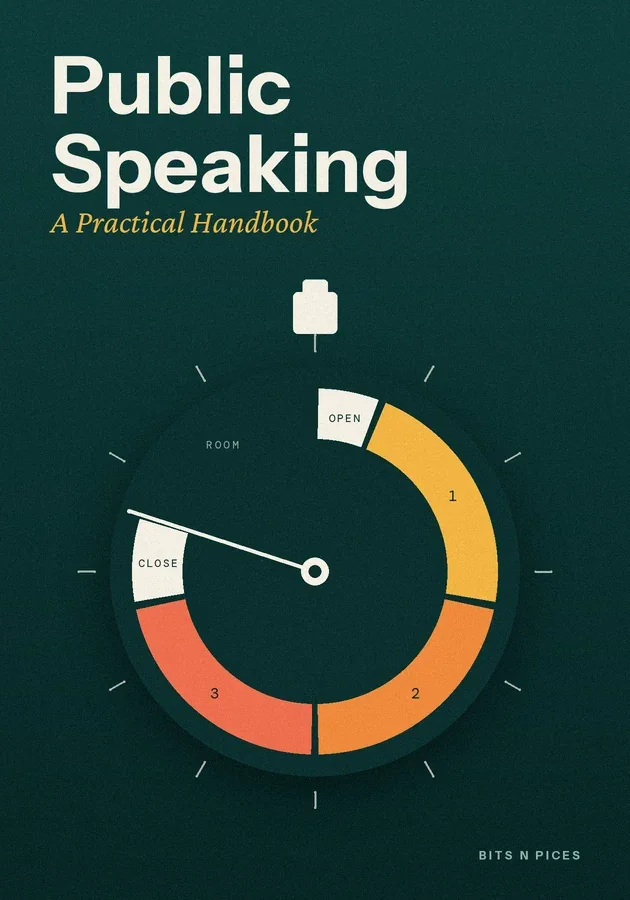
Public Speaking: A Practical Handbook
Những bài học chính
- Plan every talk, yours or your child's, on one sheet: their question, your answer in a sentence, three timed points, exact first and last lines, likely questions.
- Rehearse in pieces before running it whole: the first and last lines, each point against its time budget, then the seams between points, where most stumbles hide.
- Plan to fill about four-fifths of your slot, and when a timed run overruns, cut a whole point rather than speaking faster.
- Sort each question first: answer clarifying ones briefly, meet challenges with acknowledgement and a reason, admit what you do not know, and park off-topic ones.
- After every talk the speaker reviews first, then takes one keep and one change from a listener, so feedback builds skill instead of arguments.
Bên trong bit này
- The one-page planning sheet
Every talk in your household, whether a work update, a society meeting or a school speech, can be planned on a single sheet with five rows. Row one: who is listening and the question they walk in with.
- Rehearsing in pieces, then the seams
Running a talk from top to bottom again and again spends most of the effort on parts you already know. Rehearse in pieces instead.
- Timing, notes and slides that help
Three tools do most of the practical work. The timer: plan to fill about four-fifths of the slot, because pauses, laughter and a late start stretch every talk on the day.
- A day-of checklist for any stage
Most things that go wrong on the day are logistical, and a checklist catches them. The night before: notes in order, slides saved in two places, clothes chosen, route and timing known.
- Sorting questions before you answer them
Question time gets easier once you notice that questions come in four kinds, each with its own procedure. A clarifying question, such as when does this start, gets a short answer and a check: does that cover it?
- Feedback that improves the next talk
Feedback has a procedure too, and the order matters. The speaker reviews first: what went well, what felt shaky.
Học theo sáu cách
Trực quan hoá, Sơ đồ tư duy, Thực hành, Tình huống, Thử thách và Ôn tập được viết riêng cho cuốn sách này.
Trắc nghiệm và flashcard
Kiểm tra những gì bạn đã đọc và ghi nhớ lâu hơn với lặp lại ngắt quãng.
Bits AI
Trợ lý này trả lời dựa trên cuốn sách, phần học, hay câu trắc nghiệm mà bạn đang làm.





