

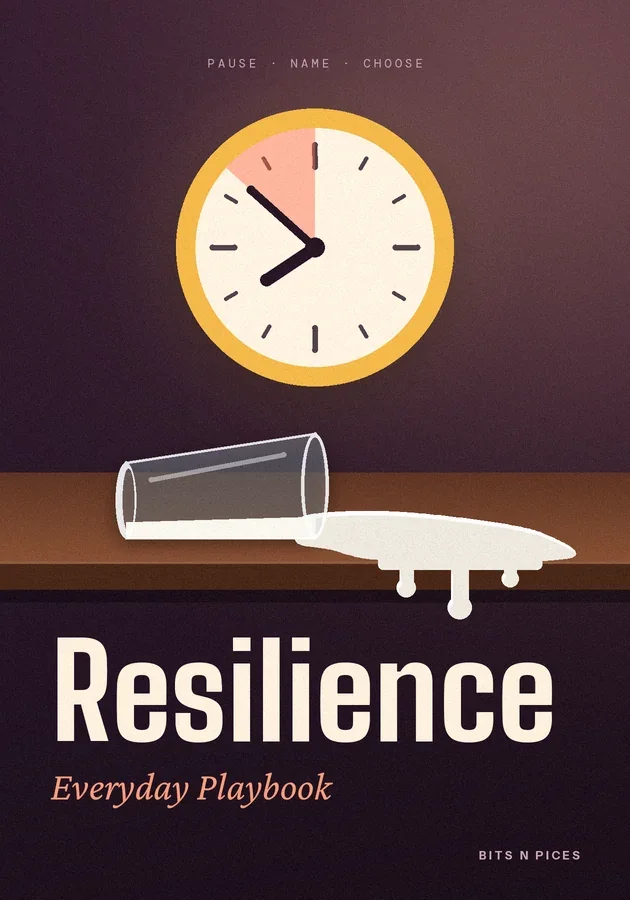
Resilience: Everyday Playbook
Những bài học chính
- Under every family play sits one move: pause, name what is happening, then choose your response instead of reacting on autopilot.
- When a morning collapses, lower your voice, give one instruction to one child at a time, and fix tomorrow's pressure point that same evening.
- When your child is hurt by friends, listen fully and ask what happened next before offering any plan or calling anyone.
- When plans fall through, let the disappointment land first, then offer a plan B that your children help to choose.
- After you lose your temper, come back calm, own it in one sentence, reconnect, and agree what you will both try next time.
Bên trong bit này
- The move underneath every play
Resilience is the ability to handle hard moments and bounce back from them. In a family it gets tested in ordinary places: the kitchen at seven in the morning, the car after school, the evening a plan collapses.
- When the morning falls apart before eight
The situation: a shoe is missing, someone has spilled milk, the bus comes in ten minutes and voices are rising. The play has three parts.
- When your child comes home hurt by friends
The situation: your child gets into the car unusually quiet, or says nobody played with them, or a friend said something unkind. The instinct is to fix it fast, by ringing another parent or telling your child to find new friends.
- When plans fall through at the last minute
The situation: the beach trip is rained off, a cousin's birthday party is cancelled, or the promised film night falls through because you have to work late. Children feel these letdowns sharply, and so do adults.
- When you lose your temper
Every parent snaps sometimes. This play is not about never shouting; it is about repair, which teaches children something just as valuable: relationships survive mistakes.
- When the whole family is under strain
Some stretches are bigger than a bad morning: a house move, a job loss, a grandparent's illness, money getting tight. The play here is steady rather than dramatic.
Học theo sáu cách
Trực quan hoá, Sơ đồ tư duy, Thực hành, Tình huống, Thử thách và Ôn tập được viết riêng cho cuốn sách này.
Trắc nghiệm và flashcard
Kiểm tra những gì bạn đã đọc và ghi nhớ lâu hơn với lặp lại ngắt quãng.
Bits AI
Trợ lý này trả lời dựa trên cuốn sách, phần học, hay câu trắc nghiệm mà bạn đang làm.





