

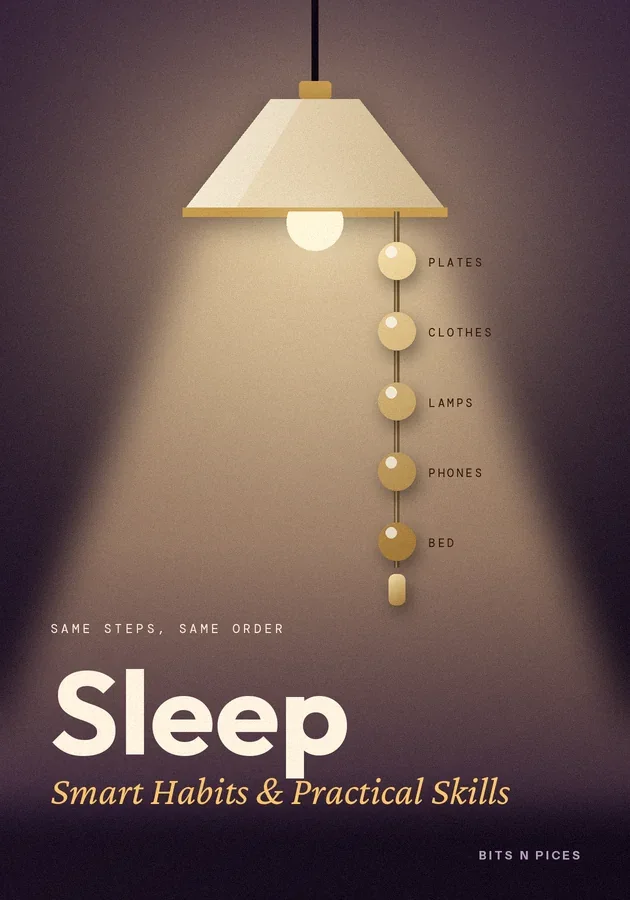
Sleep: Smart Habits & Practical Skills
Những bài học chính
- Build bedtime on a short chain of the same steps in the same order, so the evening runs on habit instead of nightly negotiation.
- Attach each new step to something the family already does, such as after the plates are cleared, we lay out tomorrow's clothes.
- Use clear cues for night and morning: lamps on at the same time each evening, curtains open and daylight at breakfast.
- Add friction to late nights by charging every device, yours included, outside bedrooms, and remove friction from sleep by preparing things in advance.
- Track the routine rather than the sleep, keep a two-step minimum version for chaotic nights, and restart the full routine on the first normal day.
Bên trong bit này
- Why bedtime runs on habits, not willpower
By eight in the evening most parents are tired, short on patience and out of good decisions. Anything that has to be argued afresh each night, bath now or later, one more episode or not, tends to slip.
- Design one evening chain for the family
The simplest way to build a new habit is to stack it: attach it to something you already do without thinking. The formula is after I do this, I will do that.
- Cues that tell the whole house it is night
A cue is anything that signals it is time for a habit to start. The strongest sleep cues work on the body clock, the internal timer that makes us alert by day and sleepy at night, which is set largely by light.
- Friction: make sleep easy and late nights harder
Friction is the effort that stands between you and an action. Small amounts change behaviour more than big intentions do: adults and children alike take the easiest path.
- Tracking that helps rather than nags
A tracker is a simple record that shows whether a habit is happening. The golden rule for families is to track the routine, not the sleep.
- Keeping it going through holidays and hard weeks
Every routine meets holidays, guests, illness and travel. The skill is not avoiding disruption but keeping the chain alive through it.
Học theo sáu cách
Trực quan hoá, Sơ đồ tư duy, Thực hành, Tình huống, Thử thách và Ôn tập được viết riêng cho cuốn sách này.
Trắc nghiệm và flashcard
Kiểm tra những gì bạn đã đọc và ghi nhớ lâu hơn với lặp lại ngắt quãng.
Bits AI
Trợ lý này trả lời dựa trên cuốn sách, phần học, hay câu trắc nghiệm mà bạn đang làm.





