

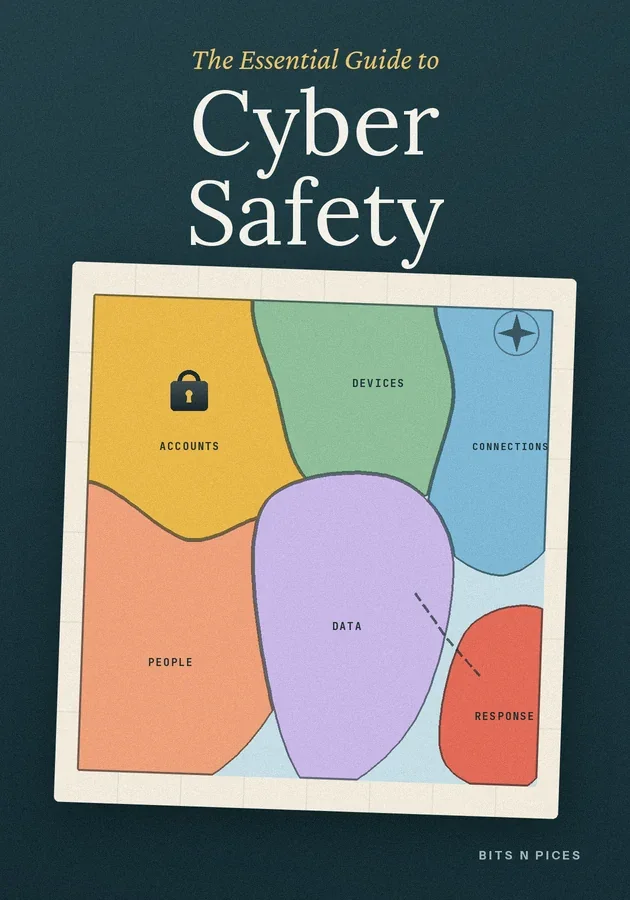
The Essential Guide to Cyber Safety
Những bài học chính
- Cyber safety has six parts, accounts, devices, connections, people, data and response, and most incidents involve two or three of them at once.
- Sort your accounts into three tiers and give the top tier, email, money and phone, your strongest passwords and two-step login first.
- Whatever a message claims, verify any request for money, codes or passwords through a channel you choose yourself, never the one it offers.
- Keep three copies of what you cannot replace, on two kinds of storage, with one kept away from home, so ransomware becomes a nuisance.
- Spend effort where attacks actually happen and safely drop rituals that add little, such as changing strong passwords every month for no reason.
Bên trong bit này
- The whole map on one page
Cyber safety feels endless because every headline adds a new threat. It becomes manageable once you see that nearly everything fits into six parts.
- Accounts: three tiers, three levels of effort
Not every account deserves the same effort, and trying to treat them all equally is why people give up. Sort them into three tiers.
- Devices and connections: keeping the ground solid
Your devices are the ground everything else stands on. Three settings cover most of the risk.
- People: the attacks that aim at trust
The most successful attacks skip the technology and go straight for people. This is called social engineering, and it works by pressing the same four buttons: urgency, authority, fear and reward.
- Data: what you share and what you keep
Data is what all the other parts protect, and it has two sides. The first is privacy, meaning control over what others learn about you.
- What to prioritise and what to ignore
Every safety step costs time or convenience, so the essential skill is choosing. Prioritise four things: two-step login and unique passwords on your top-tier accounts, automatic updates, the verify-it-yourself rule for any request involving money or codes, and backups of what you cannot replace.
Học theo sáu cách
Trực quan hoá, Sơ đồ tư duy, Thực hành, Tình huống, Thử thách và Ôn tập được viết riêng cho cuốn sách này.
Trắc nghiệm và flashcard
Kiểm tra những gì bạn đã đọc và ghi nhớ lâu hơn với lặp lại ngắt quãng.
Bits AI
Trợ lý này trả lời dựa trên cuốn sách, phần học, hay câu trắc nghiệm mà bạn đang làm.





