

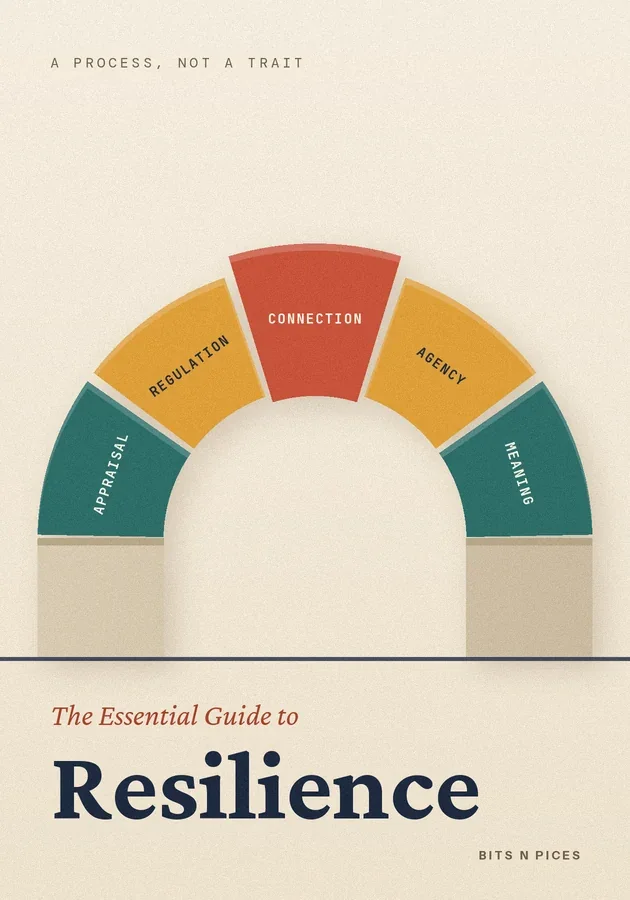
The Essential Guide to Resilience
Những bài học chính
- Resilience is a process you run, not a trait you own: it combines how you read a setback, settle your body, lean on people and act.
- Before reacting to a setback, ask three questions: is it permanent, is it everywhere, and is it all down to me? Honest answers usually shrink it.
- Recovery, not endurance, builds capacity, so protect sleep, movement and short breaks during hard weeks instead of cutting them to push through.
- Match your coping to control: act on the parts you can change, and use acceptance, perspective and support for the parts you cannot.
- Resilience has limits: when distress lasts for weeks or disrupts daily life, a doctor or counsellor is the next step, not more self-help.
Bên trong bit này
- The map: what resilience is and is not
Resilience is the capacity to adapt well when life goes wrong: to bend under pressure, keep functioning reasonably and recover, sometimes even grow, afterwards. It is not the absence of distress.
- Appraisal: how you read the setback
The same event lands differently depending on the story attached to it. Two colleagues miss the same promotion.
- Regulation: the body's alarm and recovery
When something threatens you, the body prepares to fight or flee: heart rate rises, breathing quickens and attention narrows. That alarm is useful for a near-miss on the road and costly when it runs for weeks over a difficult manager or a parent in hospital.
- Connection: the resource most people underuse
Support from other people is one of the parts of resilience most consistently linked to recovery, and one of the first dropped under pressure. People withdraw when they are struggling because they do not want to be a burden, or because explaining feels like more work.
- Agency and meaning: acting where it counts
Some parts of a problem can be changed and some cannot, and resilient coping matches effort to which is which. For the changeable parts, problem-focused coping works best: break the problem down, pick the next small step and do it.
- Priorities, trade-offs and where self-help ends
With limited energy, prioritise the few things that carry the most weight: sleep, one or two people you can be honest with, one small controllable action each day, and an accurate story about what happened. You can safely ignore much of what is sold as resilience, including extreme routines, relentless gratitude lists and the idea that you should feel fine quickly.
Học theo sáu cách
Trực quan hoá, Sơ đồ tư duy, Thực hành, Tình huống, Thử thách và Ôn tập được viết riêng cho cuốn sách này.
Trắc nghiệm và flashcard
Kiểm tra những gì bạn đã đọc và ghi nhớ lâu hơn với lặp lại ngắt quãng.
Bits AI
Trợ lý này trả lời dựa trên cuốn sách, phần học, hay câu trắc nghiệm mà bạn đang làm.





