

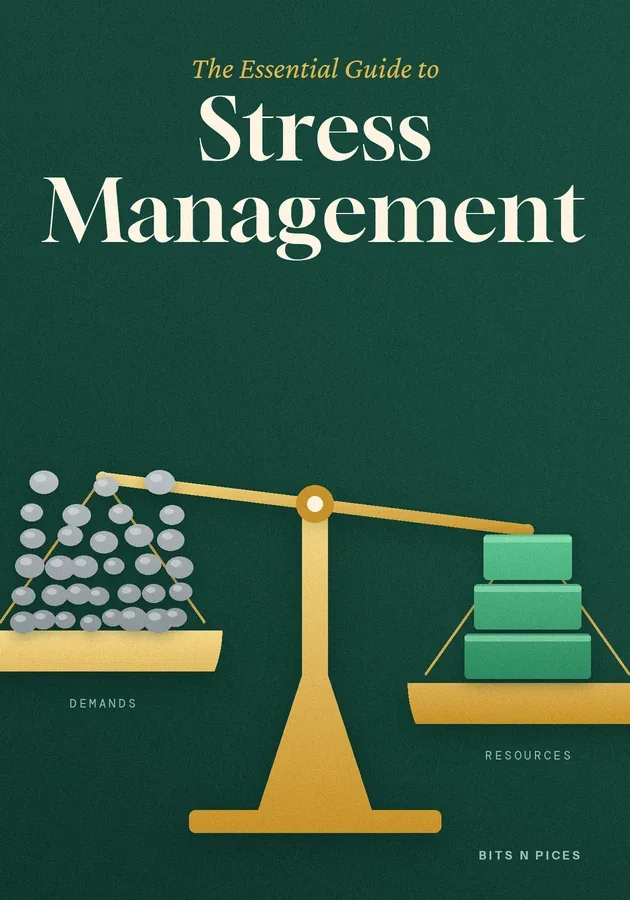
The Essential Guide to Stress Management
Những bài học chính
- Stress rises when demands outrun the resources you believe you have, so you can work on either side: lighten the load or build the resources.
- Small daily hassles add up, and repeated activation without recovery wears down capacity, so everyday irritations deserve as much attention as big events.
- The same event can feel like a challenge or a threat depending on your appraisal, but reframing cannot fix a situation that is genuinely unfair.
- Match your coping to the problem: act on what can change, soothe what cannot, and treat habitual avoidance as a loan that charges interest.
- Recovery works through detachment, relaxation, mastery and control; build several channels into every week and ignore anything promising a stress-free life.
Bên trong bit này
- The map: demands, resources and recovery
Stress management has many techniques but only a few moving parts. Demands are what life asks of you: work, care, money, noise, conflict, change.
- Why small stressors add up
Big events such as a bereavement, a move or a job loss are obvious stressors. Less obvious are the daily hassles: a slow commute, a printer that jams, a neighbour's drilling, a group chat that never stops.
- Appraisal: the story you attach
Two people can face the same presentation and have very different days. One reads it as a threat: I might be exposed.
- Matching the coping to the problem
Coping strategies fall into two broad families. Problem-focused coping changes the situation: planning, negotiating, asking for resources, learning a skill.
- Recovery has more than one channel
Recovery is not just the absence of work. It happens through several channels, and different people need different mixes.
- What to prioritise and what to ignore
With the map in view, priorities become clearer. First, protect sleep and one daily recovery block, because every other tool works better on a rested system.
Học theo sáu cách
Trực quan hoá, Sơ đồ tư duy, Thực hành, Tình huống, Thử thách và Ôn tập được viết riêng cho cuốn sách này.
Trắc nghiệm và flashcard
Kiểm tra những gì bạn đã đọc và ghi nhớ lâu hơn với lặp lại ngắt quãng.
Bits AI
Trợ lý này trả lời dựa trên cuốn sách, phần học, hay câu trắc nghiệm mà bạn đang làm.





