

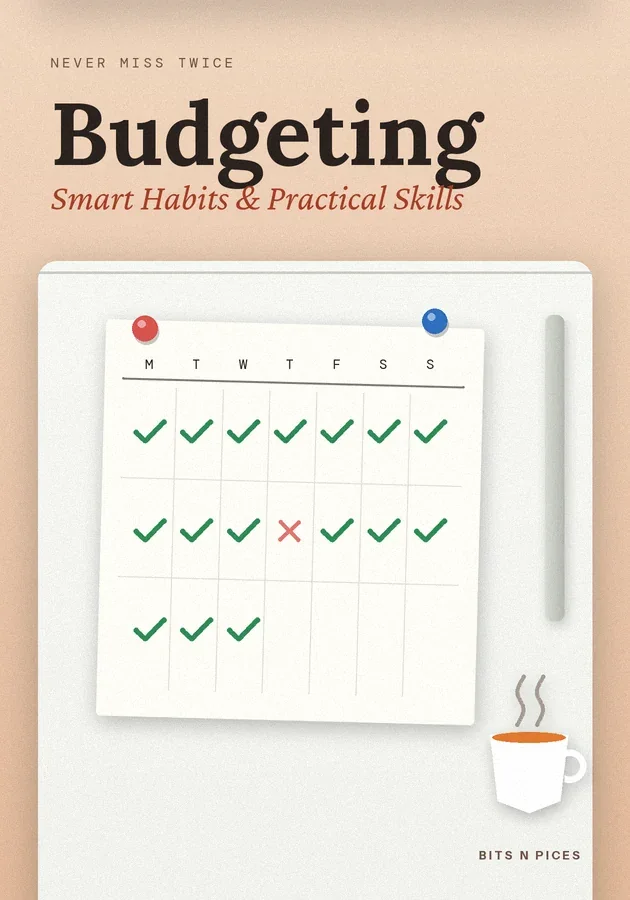
Budgeting: Smart Habits & Practical Skills
Kernaussagen
- Tie each money habit to something your family already does every day, such as morning tea or Friday dinner, so the cue is built in.
- Make good choices easy and impulsive ones slightly harder: automate saving on payday and add small pauses, like a written list, before spending.
- Track one thing the whole family can see, such as a tick chart on the fridge, rather than everything in a spreadsheet nobody opens.
- Give each child three jars, for spending, saving and sharing, and a fixed pocket-money day so they practise choosing with real money.
- When a habit breaks, never miss twice: restart with the smallest version the next day instead of waiting for a fresh month.
In diesem Bit
- Why budgeting runs on habits, not willpower
A budget is simply a plan for your money: what comes in, what goes out and what you keep. Most parents already know roughly what theirs should say.
- Anchoring money habits to routines you already have
The easiest way to start a new habit is to attach it to an old one. This is often called habit stacking: after I do the thing I already do, I will do the new thing.
- Friction: making the right choice the easy one
Friction is anything that makes an action slightly harder. Habits follow the path of least effort, so the trick is to remove friction from what you want more of and add it to what you want less of.
- Tracking the whole family can see
Tracking means recording what you do so you can spot patterns. Many parents give up on it because they try to log everything in a spreadsheet nobody else ever opens.
- Small routines that teach children about money
Children learn money habits mostly by watching and practising, not by being told. Routines make that practice regular.
- Keeping the habits going when life gets busy
Every family routine breaks eventually: a holiday, an illness, exam season, a new baby. The habit that survives is the one that restarts quickly.
Lerne es auf sechs Arten
Visualisierung, Mindmap, Praxis, Szenario, Challenge und Review wurden für dieses Buch erstellt.
Quiz und Karteikarten
Teste, was du gelesen hast, und behalte es durch Spaced Repetition im Gedächtnis.
Bits AI
Es beantwortet Fragen zum Buch, zum Abschnitt oder zur Quizfrage, bei der du dich gerade befindest.





