

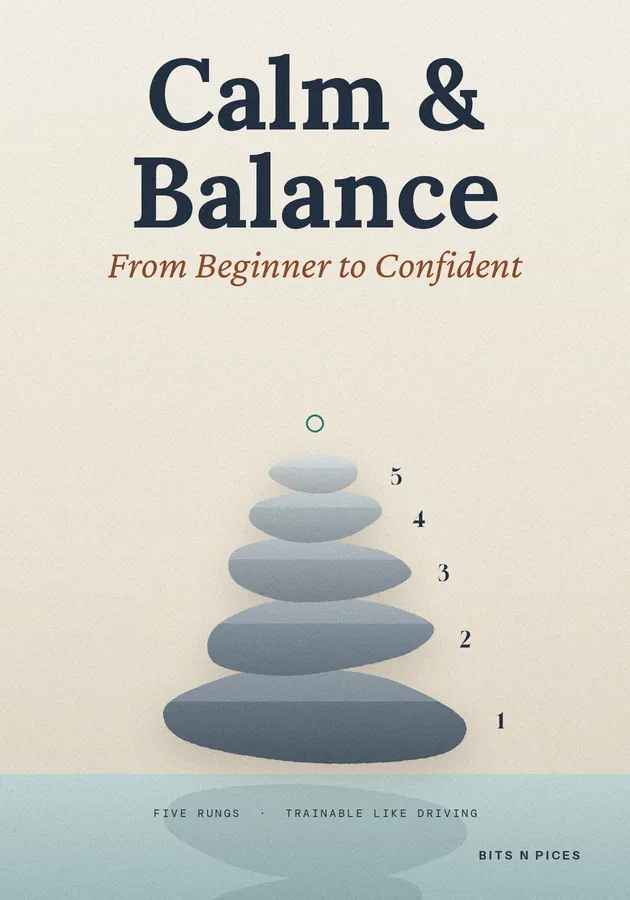
Calm & Balance: From Beginner to Confident
Kernaussagen
- Calm is a trainable skill rather than a personality trait, and it grows in recognisable stages, the way driving or cooking does.
- Start by replaying stressful moments at the end of the day; noticing late is the normal first rung, not a failure.
- Practise settling techniques when you are already calm, then under mild pressure, so they are still there when the pressure is real.
- Balance is built into the week through protected recovery, fewer avoidable collisions and a fixed restoring routine, not found on a spare day.
- You have moved up a rung when you catch stress earlier, recover faster and choose your words, even though feelings still arrive.
In diesem Bit
- Why calm is a skill you can train
Many people treat calm as something you either have or lack, like height. It behaves far more like driving.
- Rung one: seeing it afterwards
At the first rung you notice stress only once it has passed. You realise on the bus home that you were short with a colleague, or that your shoulders have been up by your ears all afternoon.
- Rung two: catching it as it happens
The second rung moves noticing from the end of the day into the moment itself. The gap between trigger and awareness shrinks from hours to minutes, then to seconds.
- Rung three: settling on purpose
At the third rung you can bring your own stress down deliberately, rather than waiting for it to fade. Two tools carry most of the load.
- Rung four: building balance into the week
The first three rungs deal with moments. The fourth deals with the conditions that create those moments.
- Rung five: steady under pressure
At the top rung, stress still arrives, but you meet it with choices rather than reflexes. You catch it in seconds, settle within a minute, respond with words you chose and recover within hours rather than days.
Lerne es auf sechs Arten
Visualisierung, Mindmap, Praxis, Szenario, Challenge und Review wurden für dieses Buch erstellt.
Quiz und Karteikarten
Teste, was du gelesen hast, und behalte es durch Spaced Repetition im Gedächtnis.
Bits AI
Es beantwortet Fragen zum Buch, zum Abschnitt oder zur Quizfrage, bei der du dich gerade befindest.





