

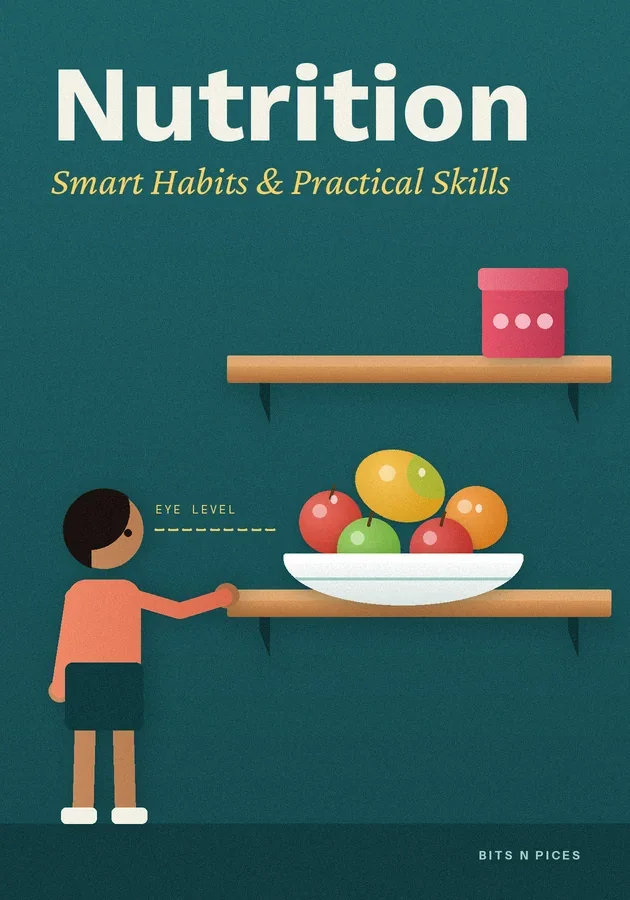
Nutrition: Smart Habits & Practical Skills
Kernaussagen
- Most family food choices are made once, at the shop and in how the kitchen is arranged, so design those moments instead of relying on evening willpower.
- Attach each new habit to a moment you already have, like packing school bags or pouring morning tea, and add only one at a time.
- Make wanted choices easy and visible, such as washed fruit at a child's eye level, and make treats less convenient rather than forbidden.
- Talk about food neutrally at home: no good or bad labels, no sweets as rewards and no comments on anyone's body.
- Track the household's systems rather than your children's plates, and before busy weeks write a minimum version of every habit.
In diesem Bit
- Why family eating runs on defaults
Most of what a family eats is decided without anyone deciding. Children reach for what is visible, adults grab what is quick, and everyone drinks whatever is already in the fridge.
- Anchoring new habits to moments you already have
A habit forms when an action is repeated in response to the same cue until it happens without effort. The cue is the part parents most often leave out.
- Friction: easy, visible and never forbidden
Friction is the small effort standing between a person and a choice: a lid to open, a shelf to reach, a shop to walk to. Lower it for the foods you want eaten more often.
- Weekly systems that remove the evening question
Tired parents rarely choose badly for lack of knowledge; they choose badly because the decision arrives at the worst moment. Systems move the decision earlier.
- How the family talks about food
Words at the table become the voice children carry into their own eating. Labelling foods as good or bad, junk or clean, tends to attach guilt to eating without teaching anything useful.
- Tracking the system and planning for lapses
Track the household system, not anyone's plate. A fridge sheet listing two or three habits, such as fruit bowl refilled, water jug on the table and one screen-free family dinner, with a box for each day, shows at a glance whether the design is working.
Lerne es auf sechs Arten
Visualisierung, Mindmap, Praxis, Szenario, Challenge und Review wurden für dieses Buch erstellt.
Quiz und Karteikarten
Teste, was du gelesen hast, und behalte es durch Spaced Repetition im Gedächtnis.
Bits AI
Es beantwortet Fragen zum Buch, zum Abschnitt oder zur Quizfrage, bei der du dich gerade befindest.





