

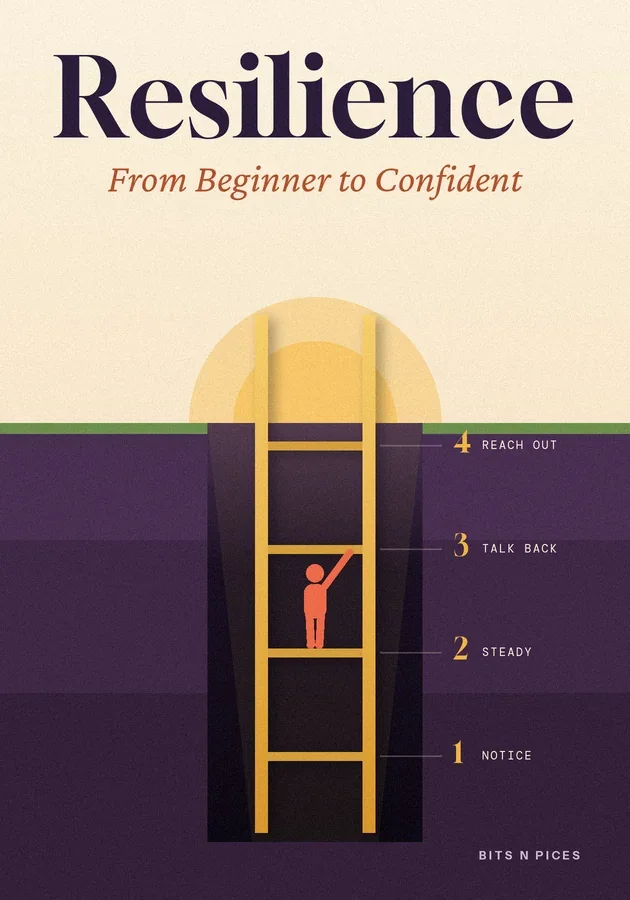
Resilience: From Beginner to Confident
Kernaussagen
- Resilience is a skill you build in stages: noticing stress, steadying yourself, rethinking the setback, then reaching out and taking action.
- Learn your personal stress signals in your body, thoughts and behaviour, because you can only steady what you have noticed.
- When stress rises, slow your breathing so each breath out lasts a little longer than the breath in, then name what you feel.
- Talk to yourself about a setback the way a good friend would: honest about what went wrong, kind about who you are.
- Measure progress by how quickly you recover, not by how little you feel, and practise on small, chosen challenges every week.
In diesem Bit
- The ladder and where you stand today
Resilience means being able to cope with setbacks and get back on your feet afterwards. It is not a gift that some people have and others lack.
- Rung one: noticing your stress signals
Stress is your body and mind reacting to something that feels threatening or like too much to handle. It leaves clues in three places.
- Rung two: steadying yourself in the moment
Once you have noticed stress, the next skill is steadying, which means calming your body enough to think clearly. When stress rises, your breathing speeds up and your attention narrows.
- Rung three: talking back to the setback
After a setback, a voice in your head usually delivers a verdict, and it is often harsh: I'm hopeless, this always happens, everyone saw. Rethinking, sometimes called reframing, means checking that verdict and replacing it with something fairer and more useful.
- Rung four: reaching out and taking a step
The top rung has two parts. The first is reaching out: telling someone what is going on and letting them help.
- Practising deliberately and spotting your progress
You build resilience the way you build fitness: by practising on purpose with manageable challenges, then recovering. Choose small stretches that make you slightly uncomfortable, such as speaking first in a meeting, returning a faulty item or asking a stranger for directions.
Lerne es auf sechs Arten
Visualisierung, Mindmap, Praxis, Szenario, Challenge und Review wurden für dieses Buch erstellt.
Quiz und Karteikarten
Teste, was du gelesen hast, und behalte es durch Spaced Repetition im Gedächtnis.
Bits AI
Es beantwortet Fragen zum Buch, zum Abschnitt oder zur Quizfrage, bei der du dich gerade befindest.





