

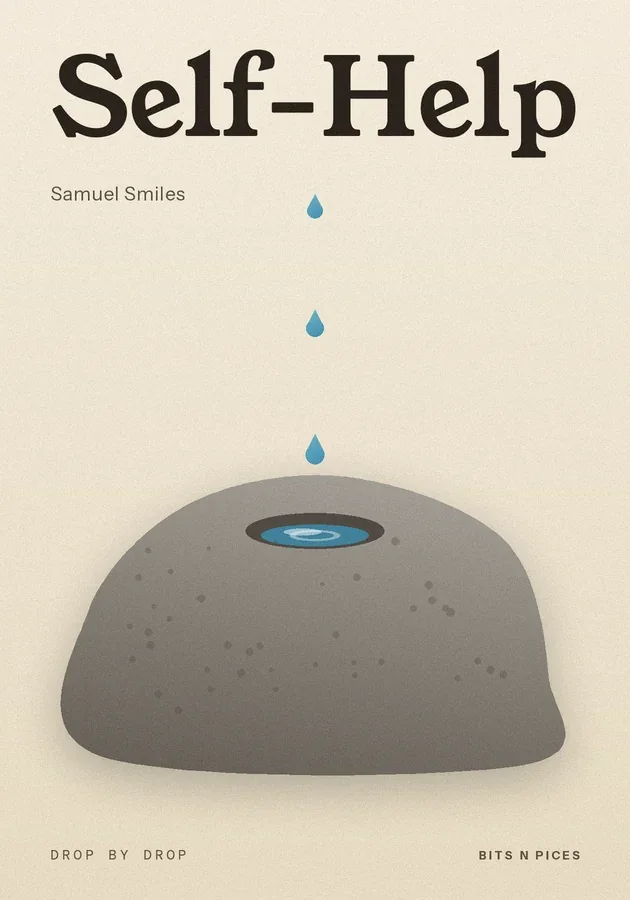
Self-Help
Kernaussagen
- Durchschnittliche Begabung mit Beharrlichkeit schlägt unbeständiges Genie
- Genutzte freie Minuten bringen mehr als das Warten auf freie Tage
- Schon kleine Ersparnisse schenken die Freiheit, Nein zu sagen
- Charakter reift im Verborgenen und zahlt sich als Vertrauen aus
- Deine Zukunft hängt mehr vom Fleiß ab als von Gönnern oder Glück
In diesem Bit
- Das erste Selbsthilfebuch der Welt
Published in 1859, Samuel Smiles's Self-Help gave a whole genre its name, and it sold in huge numbers across Victorian Britain and far beyond, including in Japan and India. Smiles began with lectures to working men in Leeds who had no money and little schooling, and his message was that their future depended less on governments or patrons than on their own diligence, character, and persistence.
- Ausdauer schlägt Talent
The heroes of Self-Help are rarely geniuses. Smiles tells of James Watt patiently improving the steam engine over years of failure, George Stephenson teaching himself to read at 18 while working in a colliery, and Josiah Wedgwood experimenting with countless clay mixtures before his pottery succeeded.
- Kleine Schritte, stetig wiederholt
Smiles pays close attention to how great work actually happens: not in bursts of inspiration but in the disciplined use of ordinary hours. He describes people who learned languages on their walk to work, scientists who ran experiments before dawn, and writers who filled notebooks in the gaps of a working day.
- Geld, Sparsamkeit und Freiheit
A long chapter deals with money, and Smiles's view is that saving is less about wealth than about freedom. A person with no reserve must accept whatever terms are offered, while even a small cushion lets you refuse a bad deal, wait for a better job, or survive a setback.
- Charakter ist das wahre Kapital
For Smiles, the final measure of a life is character: honesty, courtesy, reliability, and the courage to do the right thing when it costs something. He argues that skill without integrity is dangerous and that a reputation for keeping your word is worth more than any single deal.
- In die Praxis umsetzen
Choose one skill you have been meaning to learn and give it 20 minutes every day this week, in the gaps you already have, such as a commute or the time before breakfast. Set up a small automatic saving, even a tiny one, so that the habit begins before the amount matters.
Lerne es auf sechs Arten
Visualisierung, Mindmap, Praxis, Szenario, Challenge und Review wurden für dieses Buch erstellt.
Vertont
Hör dir dieses Bit an, gelesen von Michael oder Bella.
Quiz und Karteikarten
Teste, was du gelesen hast, und behalte es durch Spaced Repetition im Gedächtnis.
Bits AI
Es beantwortet Fragen zum Buch, zum Abschnitt oder zur Quizfrage, bei der du dich gerade befindest.





