

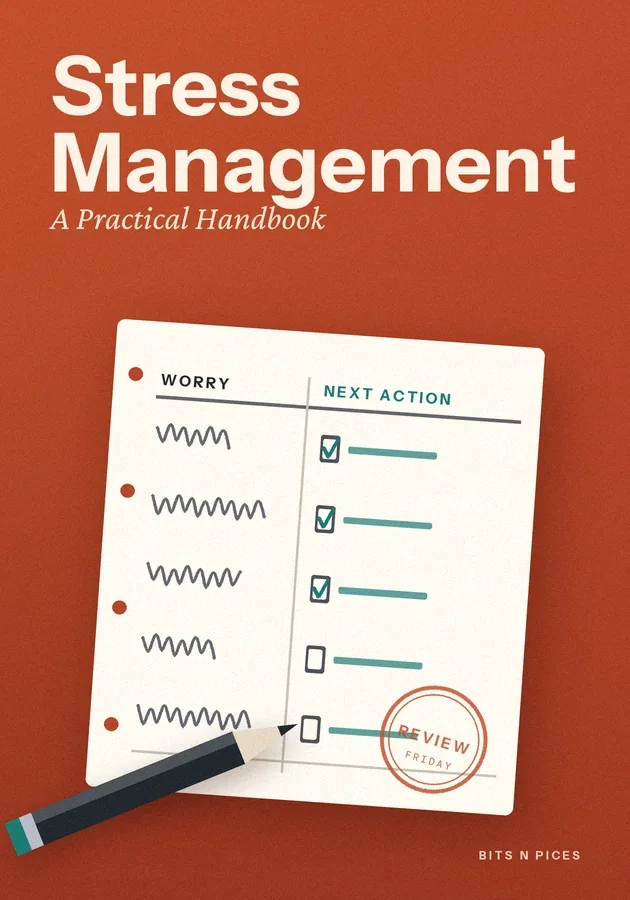
Stress Management: A Practical Handbook
Kernaussagen
- Audit your household for one week to find its pinch points, then change the stretch of the day that creates most friction, not everything at once.
- Build a short transition routine between work and home so your family meets you after the workday has settled, not in the middle of it.
- Park worries on a worry-and-plan sheet with a next action and a review date, so they stop following you into bedtime and family time.
- In a child's hard moment, steady yourself first, use fewer words and delay the lesson, because calm spreads through a household faster than advice.
- Review routines weekly and watch for tools that backfire; persistent worry in you or your child is a reason to talk to a professional.
In diesem Bit
- Running a one-week household stress audit
Before changing anything, find out where stress actually concentrates in your home. For seven days, keep a simple sheet on the fridge with the hours of the day down one side.
- The evening transition routine, step by step
Many parents walk through the door still inside the workday, carrying the last difficult call into the first conversation with their children. A transition routine creates a buffer, and it works best as a fixed sequence you can run on autopilot on your worst day.
- A worry-and-plan sheet that actually works
Worries that live only in your head expand to fill quiet moments, which for parents usually means the bedtime story and the last hour before sleep. The worry-and-plan sheet moves them onto paper.
- Scripts for a child's hard moments
When a child is overwhelmed, the fastest route back to calm runs through the adult. Children read faces and voices long before they process words, so the first step is steadying yourself: drop your shoulders, lower your voice, slow your speech.
- Running a weekly family planning meeting
Many household stress spikes come from collisions nobody saw coming: two activities at the same time, a forgotten school project, a relative visiting in exam week. A fifteen-minute meeting each weekend catches most of them.
- Troubleshooting, limits and getting support
Every tool here can backfire, and knowing how is part of using it well. Rest can become another task you feel you are failing.
Lerne es auf sechs Arten
Visualisierung, Mindmap, Praxis, Szenario, Challenge und Review wurden für dieses Buch erstellt.
Quiz und Karteikarten
Teste, was du gelesen hast, und behalte es durch Spaced Repetition im Gedächtnis.
Bits AI
Es beantwortet Fragen zum Buch, zum Abschnitt oder zur Quizfrage, bei der du dich gerade befindest.





